

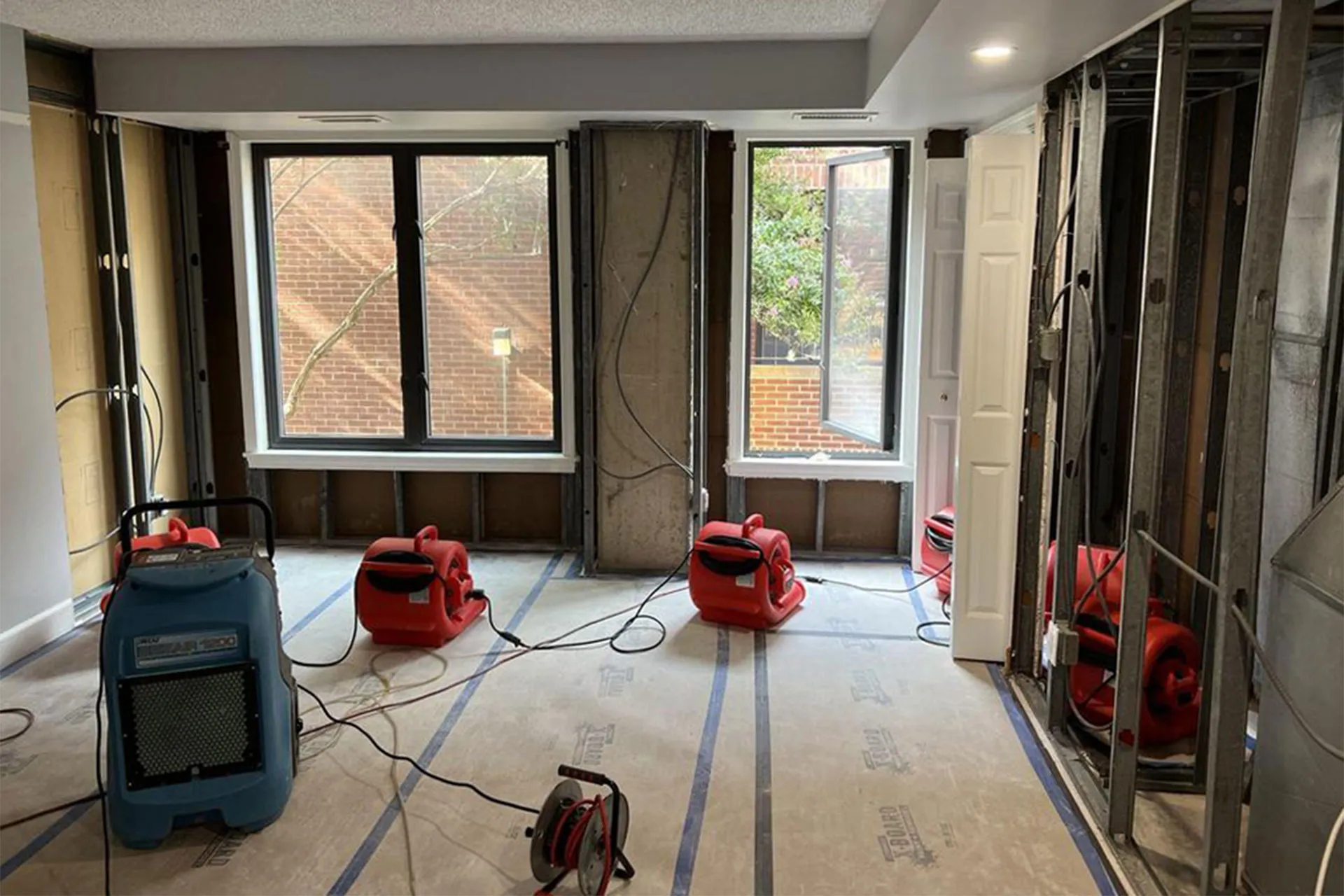
Take an inventory of what your business owns and where it is right now. The dehumidifiers are in a basement across town. The air movers are in a house on the other side of the county. The air scrubbers are on a fire job, the generator is standing on somebody’s exterior, the radon fans are staged for an install tomorrow. Your yard is mostly floor. You own all of it, and almost none of it is anywhere near you.
That is the exposure this post is about. Contractors equipment is the line written for it, and its coverage page owns the architecture: how the schedule is built, what the form does in transit and on site, how rented gear is handled. What follows is narrower. It is about the odd arithmetic of owning a fleet whose entire job is to be somewhere you are not.
Property insurance answers an address
The blind spot starts with a mental model, and the model is not wrong — it just belongs to a different kind of business.
Almost everything an owner absorbs about insuring property is organized around a place. There is a building. There is equipment inside the building. A policy names the address and answers what happens there. That is how a shop gets covered, how an office gets covered, and how nearly every business outside the trades thinks about protecting what it owns. It is a sound model, and it has one requirement: the property has to be at the place.
Now look at your fleet’s defining characteristic. It is never at the address — not occasionally, structurally. If your equipment is at the yard, it is not earning. If it is earning, it is not at the yard. A policy organized around a location therefore answers your gear only during the hours it is doing nothing for you, and steps out of the picture the moment it goes to work. That is not a small gap at the edge of the coverage. It is the entire working life of the equipment.
Contractors equipment is built the other way around: it follows the gear instead of the ground. That is the whole reason a separate line exists for trades whose property is mobile by design, and why the fixed-location instinct is the first thing worth unlearning here.
The night your yard is empty
Here is the part that is genuinely uncomfortable, and it is only arithmetic. Your fleet’s exposure and your business’s health move in the same direction.
On a slow week, most of the gear is home — behind a fence you control, inside a building you locked, on a lot you can see. Your exposure is low. So is your revenue. Then a storm comes through, or a pipe lets go in a commercial building overnight, or the calls simply stack up the way they do in a bad season, and every piece of equipment you own goes out the door at once. On the best night your business has all year, effectively all of your working capital is running unattended in strangers’ buildings — on properties that are wet, damaged, often unoccupied, and frequently not locked at all.
That is not a discipline problem you could fix with better habits. It is what responding to losses is. But it means the intuition that says we are busy, so we are fine runs exactly backwards on this line. The night your yard is emptiest is the night the smallest possible share of what you own is anywhere you could protect it.
The site is a covered loss. Your gear is not part of it.
This one is specific to working inside the claims process for a living, and it is easy to slide into without noticing.
You spend your entire week inside insured events. The house is a covered loss. The adjuster on the loss is walking it with a tablet. There is a claim number, there is a scope of repair, there is paperwork moving in every direction. The whole environment radiates the message that this situation is handled — and your air scrubber is standing in the middle of it, humming away.
It is not part of that claim. The property owner’s insurance carrier is answering the property owner’s loss under the property owner’s policy, and your dehumidifier does not appear anywhere on that document. If the structure shifts overnight and takes your gear down with it, if a fire reignites, or if the equipment is simply not there in the morning, none of the paperwork you have been swimming in all week reaches any of it. You are working inside somebody else’s covered event, and the thing you own is a stranger to it. A claim for your equipment is a claim on your policy — yours, the contractor’s — or it is nothing at all.
Real-World Scenario: A restoration company responds to a large water loss in an unoccupied house and sets its drying fleet — dehumidifiers, air movers, and an air scrubber — to run around the clock. The property is a covered loss with a claim open on it, and the crew is working within the claims process the way it does every week. Overnight, the equipment is taken off the site. In the morning the company is missing a meaningful part of what it uses to do business, and the calls it is already committed to do not pause while it works out what happened. The claim open on that house belongs to the property owner and answers the property owner’s damage; it has nothing to say about a contractor’s dehumidifiers, and there is no reason it should. The gear was on the site, but it was never in the claim. Whether the company is made whole comes down to a policy of its own, written to follow its equipment out to a property it does not control.
Nobody has to be at fault
This is the part worth enjoying, because for once the structure cuts your way.
Most of the coverage conversation in this trade is about liability, and liability needs a narrative: somebody was harmed, somebody is to blame, and somebody has to answer for it. Contractors equipment does not work that way. It is a first-party line, which means the story is much shorter — it is your property, something happened to it, and your own policy answers you. Whether a door was left open, whether a gate got propped, whether anyone is ever identified: none of that has to be established before you are made whole.
That matters because of what the alternative looks like. Without this line, an equipment loss on a site you do not control becomes a project. Work out who was responsible. Establish that they were. Find out whether they carry anything worth pursuing. Wait. Meanwhile the phone keeps ringing with work you cannot take, because in this business the fleet is not an asset on a schedule — it is the operation. Losing it does not just cost you the equipment, it costs you every job you could not respond to while you were arguing about who is at fault. First-party coverage deletes that entire project and replaces it with a claim on your own policy. It is the difference between a bad night and a bad quarter.
What else is on that truck
Two things ride out with your gear that are not your gear, and both have their own line. They are worth naming so you do not assume this one stretches over them.
The first is your customers’ property. When a crew packs out furniture, electronics, textiles, and boxes, none of that belongs to you. It is in your care, and it runs through bailees coverage — a different line with different reasoning. Both loads are mobile, both sit off your premises, and both are on the same truck on the same road, which is exactly why they get confused. The line is ownership. Your gear is contractors equipment; their belongings are not, however carefully you are holding them. The mechanics of that line are the bailees page’s ground and worth reading there.
The second is the truck itself. Your equipment’s transit exposure — gear damaged loading, shifting, or on the road — is contractors equipment’s business. The vehicle carrying it is not: the truck, its physical damage, and its at-fault accidents belong to commercial auto. And one note on language, since this trade borders another one: your insurance carrier is the company that writes your policy, which is a different thing from a motor carrier hauling freight for hire. What we are talking about here is the fleet your own operation runs to its own jobs.
<rect x="26" y="52" width="190" height="80" rx="9" fill="#ffffff" stroke="#DCC9B0"/>
<text x="121" y="78" text-anchor="middle" font-family="Inter, system-ui, -apple-system, 'Segoe UI', Roboto, sans-serif" font-size="13" font-weight="600" fill="#12703F">A flooded basement</text>
<text x="121" y="100" text-anchor="middle" font-family="Inter, system-ui, -apple-system, 'Segoe UI', Roboto, sans-serif" font-size="12" fill="#5A5048">Dehumidifiers running</text>
<text x="121" y="120" text-anchor="middle" font-family="Inter, system-ui, -apple-system, 'Segoe UI', Roboto, sans-serif" font-size="12" fill="#5A5048">for days, unattended.</text>

<rect x="484" y="52" width="190" height="80" rx="9" fill="#ffffff" stroke="#DCC9B0"/>
<text x="579" y="78" text-anchor="middle" font-family="Inter, system-ui, -apple-system, 'Segoe UI', Roboto, sans-serif" font-size="13" font-weight="600" fill="#12703F">A fire loss in town</text>
<text x="579" y="100" text-anchor="middle" font-family="Inter, system-ui, -apple-system, 'Segoe UI', Roboto, sans-serif" font-size="12" fill="#5A5048">Air scrubbers running</text>
<text x="579" y="120" text-anchor="middle" font-family="Inter, system-ui, -apple-system, 'Segoe UI', Roboto, sans-serif" font-size="12" fill="#5A5048">on an open property.</text>

<rect x="250" y="150" width="200" height="82" rx="10" fill="#F1E5D6" stroke="#DCC9B0"/>
<text x="350" y="177" text-anchor="middle" font-family="Inter, system-ui, -apple-system, 'Segoe UI', Roboto, sans-serif" font-size="14" font-weight="600" fill="#12703F">Your yard</text>
<text x="350" y="200" text-anchor="middle" font-family="Inter, system-ui, -apple-system, 'Segoe UI', Roboto, sans-serif" font-size="12" fill="#5A5048">Emptiest exactly when the</text>
<text x="350" y="220" text-anchor="middle" font-family="Inter, system-ui, -apple-system, 'Segoe UI', Roboto, sans-serif" font-size="12" fill="#5A5048">business is at its best.</text>

<rect x="26" y="250" width="190" height="80" rx="9" fill="#ffffff" stroke="#DCC9B0"/>
<text x="121" y="276" text-anchor="middle" font-family="Inter, system-ui, -apple-system, 'Segoe UI', Roboto, sans-serif" font-size="13" font-weight="600" fill="#12703F">A storm street</text>
<text x="121" y="298" text-anchor="middle" font-family="Inter, system-ui, -apple-system, 'Segoe UI', Roboto, sans-serif" font-size="12" fill="#5A5048">Air movers and a</text>
<text x="121" y="318" text-anchor="middle" font-family="Inter, system-ui, -apple-system, 'Segoe UI', Roboto, sans-serif" font-size="12" fill="#5A5048">generator on an exterior.</text>

<rect x="484" y="250" width="190" height="80" rx="9" fill="#ffffff" stroke="#DCC9B0"/>
<text x="579" y="276" text-anchor="middle" font-family="Inter, system-ui, -apple-system, 'Segoe UI', Roboto, sans-serif" font-size="13" font-weight="600" fill="#12703F">A radon install</text>
<text x="579" y="298" text-anchor="middle" font-family="Inter, system-ui, -apple-system, 'Segoe UI', Roboto, sans-serif" font-size="12" fill="#5A5048">Fans, drills, and</text>
<text x="579" y="318" text-anchor="middle" font-family="Inter, system-ui, -apple-system, 'Segoe UI', Roboto, sans-serif" font-size="12" fill="#5A5048">sub-slab tooling.</text>

<path d="M 248 166 L 220 122" fill="none" stroke="#12703F" stroke-width="2" marker-end="url(#fleet-arrow)"/>
<path d="M 452 166 L 480 122" fill="none" stroke="#12703F" stroke-width="2" marker-end="url(#fleet-arrow)"/>
<path d="M 248 216 L 220 260" fill="none" stroke="#12703F" stroke-width="2" marker-end="url(#fleet-arrow)"/>
<path d="M 452 216 L 480 260" fill="none" stroke="#12703F" stroke-width="2" marker-end="url(#fleet-arrow)"/>

<rect x="60" y="356" width="580" height="64" rx="10" fill="#C7683F" stroke="#12703F"/>
<text x="350" y="384" text-anchor="middle" font-family="Inter, system-ui, -apple-system, 'Segoe UI', Roboto, sans-serif" font-size="15" font-weight="600" fill="#1A1A1A">Your fleet earns by leaving. It is never where you are.</text>
<text x="350" y="406" text-anchor="middle" font-family="Inter, system-ui, -apple-system, 'Segoe UI', Roboto, sans-serif" font-size="13" fill="#1A1A1A">Coverage that answers an address is watching an empty yard.</text>

<text x="350" y="440" text-anchor="middle" font-family="Inter, system-ui, -apple-system, 'Segoe UI', Roboto, sans-serif" font-size="12" font-style="italic" fill="#5A5048">First-party: your property, your own policy.</text>
<text x="350" y="458" text-anchor="middle" font-family="Inter, system-ui, -apple-system, 'Segoe UI', Roboto, sans-serif" font-size="12" font-style="italic" fill="#5A5048">Nobody has to be found at fault.</text>
The fleet you ran last week probably wasn’t all yours
Owned gear is the core of the coverage and the bulk of most fleets. But the honest reality is that big losses outrun inventory. A neighborhood after a storm, a large commercial water loss, a fire in a building with a lot of floors — a real response calls for more dehumidifiers and air movers than any sensible operation keeps sitting idle waiting for a bad week. So you rent. And the rental agreement generally makes you responsible for that equipment while it is in your possession, which is a live exposure on property you do not own.
Which means that on your biggest job, the fleet standing at the loss is part yours and part somebody’s rental: one working fleet, doing one job, exposed to one bad night. Whether your policy sees it as one fleet depends on the form and what is attached to it. Many contractors equipment forms can extend to rented or borrowed equipment in your care; whether yours does, and to what limit, is a question with a real answer. The answer should match how your business actually staffs a surge — not how the yard looks on a quiet Tuesday when everything happens to be home.
Questions to ask before the next storm call
None of this needs a clause hunt. It needs functional questions, asked of somebody who reads this trade, on a day when the fleet is where you can see it:
- If my gear is standing at a loss tonight and it is gone in the morning, which of my policies answers?
- Does that policy follow the equipment off my premises, or does it think of my fleet as living at an address?
- Equipment running unattended overnight on an open property is the normal case for me, not the exception. How does the form treat it?
- When I rent to cover a surge, is the rented gear answered the same way my own is?
- Is my schedule built around a total loss of everything I deploy at once, or around the single most expensive item I own?
Quick, specific answers mean the coverage was built for the way you actually work. Vague ones are the finding — and you would rather have it now than at the end of a night when the fleet did not come home.
Before the fleet goes back out
There is nothing exotic here. It is simply a line of business whose property refuses to behave the way property is supposed to. Your gear earns by leaving. It does its best work standing for days in somebody else’s damaged building, on a property you cannot lock, at the exact moment it is worth the most to you. Any coverage that pictures your equipment living at your address is answering a business you do not run.
Contractors equipment is the line written for the way it really works: your own property, first-party, in transit, deployed at the loss, and back at the yard on the rare night everything is home. Read it against your real deployment — the surge, the rentals, the unattended nights — rather than the quiet week, and the coverage page is worth the time for how the schedule is actually built.
Where the fleet sleeps is one of the first things we ask about on a restoration program, because it decides most of what follows. Tell us what you deploy, and we will read the coverage against a busy week rather than a quiet one.