Coverage line
Workers Compensation Insurance for Restoration & Radon Contractors
The line that answers your own crew — technicians in respirators in contaminated attics and crawlspaces, on storm work at height, at odd hours the day after a loss. It covers your employees where general liability answers the third parties around them, and in four monopolistic-fund states it does not come from a carrier at all.
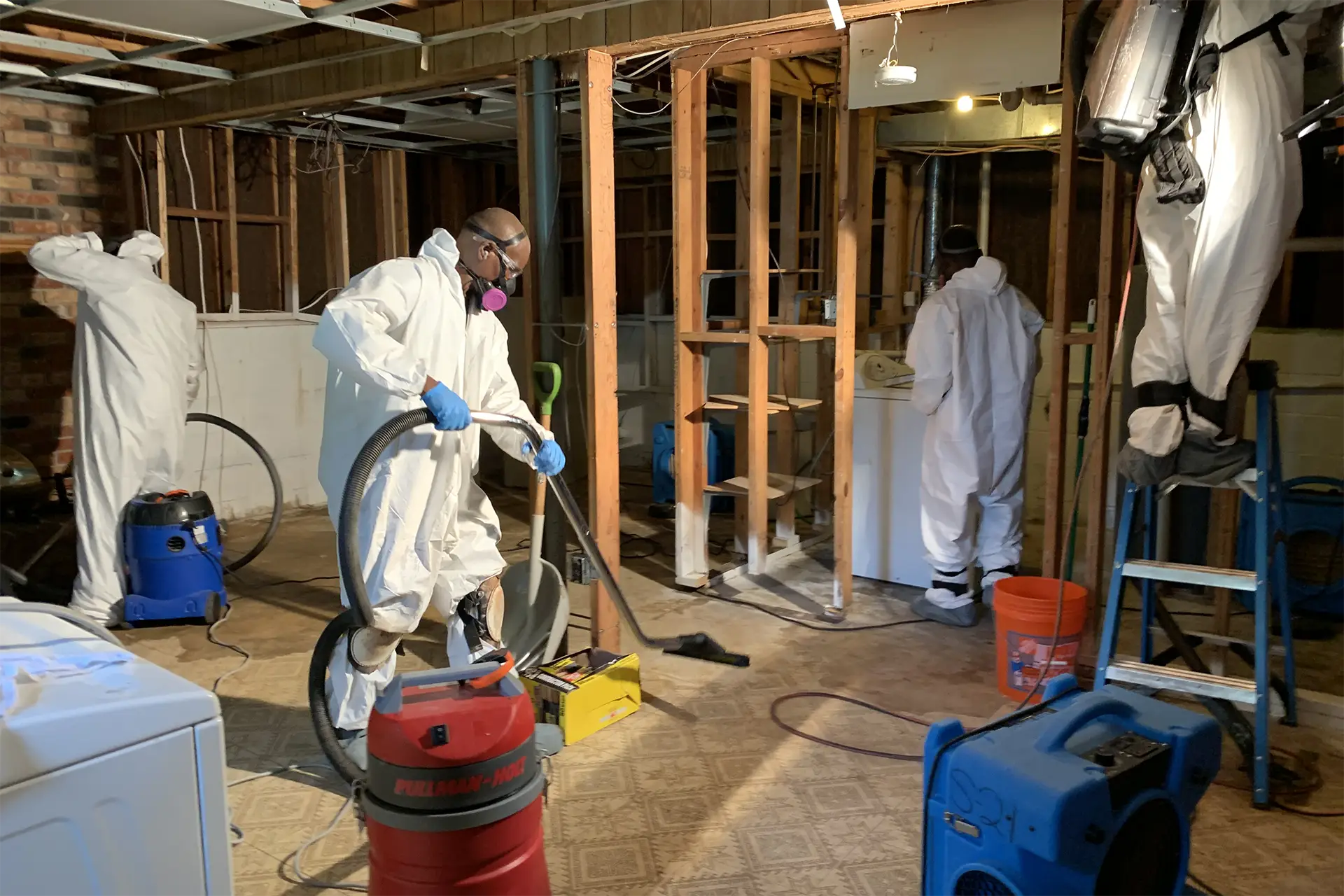

Workers compensation is the coverage that answers your own crew. When a technician is hurt or made ill doing the work — the injury, the medical treatment, the lost wages, the rehabilitation — this is the line that responds, regardless of who was at fault, and in exchange it is generally the exclusive remedy that keeps most on-the-job injuries out of a lawsuit. For a restoration or radon business that is not a formality bolted onto the program; it is coverage for the single most exposed asset the operation has, which is the people who go into the loss.
And this trade puts its people in genuinely hazardous places. A restoration or radon crew does not work in an office; it works in respirators in contaminated environments, in confined attics and crawlspaces, on storm work at height, and at odd hours the day after a loss when the damage is fresh and the pressure is highest. This page walks through where that exposure actually lives, how the experience-modification factor turns your safety discipline into cost, the seam where workers compensation stops and general liability begins, and the four monopolistic-fund states where the coverage does not come from an insurance carrier at all.
The exposure: contaminated environments, confined spaces, and height
What makes this class distinctive is that the everyday conditions of the work are the conditions safety regimes are written about. A few of them define the exposure.
Respirators and PPE in contaminated environments. Mold remediation, Category 3 water, and fire and soot cleanup put crews into air that is not safe to breathe unprotected, so respiratory protection and personal protective equipment are not optional extras — they are the job. An injury or illness tied to a contaminated environment, or to a respiratory hazard that was not controlled, is exactly the exposure workers compensation is built to answer.
Confined attics and crawlspaces. Restoration crews chase water and mold into the tightest parts of a structure, and radon crews spend their days under houses — sub-slab work, crawlspace and vapor-barrier installs, and confined-space entry are ordinary parts of the trade. Those spaces carry their own hazards: restricted movement, poor ventilation, awkward lifting, and the kind of injury that comes from working in a place a body was never meant to work in.
Storm work at height and heat in protective suits. Catastrophe response sends crews onto ladders and up onto damaged structures, and it sends them there in protective suits in the heat, hours into a long day. Falls, heat illness, and fatigue-driven injury are real parts of the storm-response reality, and the odd hours the day after a loss — when the work has to happen now — compound all of it.
None of this is theoretical. It is the ordinary texture of the work, and it is the reason a restoration or radon business needs a workers compensation program built by someone who understands that the crew is doing hazardous work in hazardous places, not filing paperwork at a desk.
Employers liability and the experience-modification factor
A workers compensation policy usually comes in two halves, and both matter here. The first is the no-fault benefit that pays an injured worker. The second is employers liability, which backstops the employment-related suits that fall outside the no-fault bargain — the situations where an injury generates a claim the exclusive-remedy rule does not neatly close. Described by function rather than by clause, it is the part of the policy that answers when an injury reaches into litigation rather than staying inside the benefit system.
The number that ties your safety record to your cost is the experience-modification factor — the multiplier that translates your own claims history into what you pay relative to a business of your size and class. For a trade with this much injury exposure, the modifier is where discipline shows up: respiratory protection, confined-space procedure, fall protection, return-to-work handling, and honest claims management all move it over time. It has also become a screen — general contractors and program relationships increasingly ask to see it before they let a subcontractor onto a job, so it is a marketing fact as much as a cost one. We discuss it qualitatively, because the figure belongs to your business and its loss history, not to a coverage page.
Where workers compensation stops: the general-liability seam
The cleanest way to understand this line is by the boundary it shares with general liability, and the boundary is simple: your crew is workers compensation’s; the third-party visitor is general liability’s. Your technician — the person on your payroll, in the respirator, in the crawlspace, on the ladder — is a workers compensation matter, because the injury is to your own employee. A third party at the same loss — a homeowner, a building occupant, a property manager, or a passer-by hurt near your equipment — is a general liability matter, because the injury is to someone who is not your crew.
The same event can trip both lines at once, which is why the distinction is worth keeping straight. The air mover a visitor trips over is a general liability claim; the same air mover your technician wrenches a shoulder carrying is a workers compensation claim. One event, two lines, drawn on the single question of whose injury it is. Everything else on the program sits outside both: the pollutant the crew removes runs through contractors pollution liability, the professional opinion behind a measurement through professional liability, your drying and radon gear through contractors equipment, and your response fleet through commercial auto. Workers compensation answers one thing well: an injury to your own people.
The monopolistic-fund states: where the coverage is not from a carrier
There is a piece of the workers compensation map a multi-state restoration or radon business has to know about, and it surprises operators who assume the coverage works the same everywhere. In four states — North Dakota, Ohio, Washington, and Wyoming — workers compensation is monopolistic, which means the coverage does not come from a private insurance carrier at all. In those states an employer buys the coverage directly from the state fund rather than from a carrier on any panel, and the private policy we place for the rest of your footprint does not simply stretch to cover a worker there.
This is regulatory context, not a product we sell — the state fund is the mechanism, and our job is to make sure the rest of your program is arranged around it correctly. It matters most for a business that crosses state lines, which in this trade is common: a restoration operation that mobilizes for a named storm two states away, or a radon business that works a metro straddling a border, can end up with a technician in a state where the coverage has to come from the fund and not from the policy. When one of your operating states is a monopolistic one — and Ohio, for example, is among them — we flag it so the coverage is placed the right way in each state rather than assumed to be uniform across the map.
Why restoration and radon businesses need it
In most states workers compensation is legally required once you have employees, so for a restoration or radon business with a crew it is rarely optional. But the reason to place it carefully is not just the mandate; it is that this is the coverage standing between an injured technician and the survival of the business. A serious injury on a contaminated loss or a fall on storm work is a human event first and a financial one immediately after, and a program that was built to the real work — the right classifications, an honest state schedule, and the exposures named rather than glossed — is what keeps that event from becoming an uncovered one.
It also travels with your bids. The experience-modification factor and the certificate of workers compensation are among the first things a general contractor or a program relationship asks a restoration subcontractor to show, so the same coverage that protects your crew is part of how you win the work. We rate the program to the operation you actually run — mitigation and reconstruction, measurement and mitigation, or a mix — rather than to a generic contractor class.
Learn more
Coverage for a restoration or radon business works as a system. Workers compensation answers your crew; the line beside it, general liability, answers the third parties around them, and the rest of the program answers everything neither one does — contractors pollution liability for the mold, sewage, and smoke and soot your crew removes, professional liability for the measurement opinion, bailees coverage for the customers’ contents in your care, contractors equipment for your drying and radon gear, commercial auto for the response fleet, and excess liability when a contract demands limits above your primary layer. How it is written also differs by the operation across the two service pillars — Restoration Contractor Insurance and Radon Mitigation Business Insurance.
The line it shares a seam with
The rest of the program
- Contractors Pollution Liability Insurance
- Professional Liability Insurance
- Bailees Coverage
- Contractors Equipment Insurance
- Commercial Auto Insurance
- Excess Liability Insurance
Insurance by the operation you run
Get covered
Primary sources
Frequently asked questions about Workers Compensation Insurance
What does workers compensation cover for a restoration or radon business?
Workers compensation answers a work-related injury or illness to your own employee — medical treatment, lost wages, and rehabilitation — regardless of fault, and in exchange it is generally the exclusive remedy that keeps most on-the-job injuries out of a lawsuit. For a restoration or radon crew the exposure is not incidental office risk; it is the real hazard of the work: a technician in a respirator in a contaminated attic, a crawlspace entry on a sub-slab job, storm work at height, and long hours the day after a loss. It answers your crew. It does not answer a third party hurt at the job site — a visitor or occupant near your equipment — which is general liability, and it does not answer the pollutant, the professional opinion, or your equipment, which are their own lines.
Where is the line between workers compensation and general liability?
It is the line between your own people and everyone else. Your technician — the person on your payroll, in the respirator, in the crawlspace, on the ladder — is a workers compensation matter, because the injury is to your employee. A third party at the same loss — a homeowner, a building occupant, a property manager, or a passer-by hurt near your air movers — is a general liability matter, because the injury is to someone who is not your crew. The same event can trip both lines at once: the fan that a visitor trips over is general liability, and the fan your technician strains a back moving is workers compensation. Employers liability, the second half of a workers compensation policy, then backstops the employment-related suits that fall outside the no-fault bargain.
How do the monopolistic state funds work for a restoration or radon crew?
In four states — North Dakota, Ohio, Washington, and Wyoming — workers compensation is monopolistic, which means the coverage does not come from a private insurance carrier at all. An employer with operations in those states buys the coverage from the state fund itself rather than from a carrier on our panel. That matters for a restoration or radon business that crosses state lines chasing storm work or runs crews in more than one state, because the placement, the reporting, and the way the injury is administered are different there, and the private policy we place does not simply stretch to cover a worker in a monopolistic state. We flag which of your operating states are monopolistic so the coverage is arranged the right way in each rather than assumed to be uniform.
Does the experience-modification factor matter for this trade?
It matters a great deal, because it is the multiplier that translates your claims history into what you pay, and it follows you onto bids. A crew that works in contaminated environments, in confined spaces, and at height carries real injury exposure, so the discipline that keeps injuries down — respiratory protection, confined-space procedure, fall protection, and honest claims handling — shows up over time in the modifier and in your cost of risk. General contractors and program relationships increasingly ask for it as a screen before they let a subcontractor on a job. We discuss it qualitatively rather than quoting a figure, because the number is specific to your business and its loss history, not something to invent on a coverage page.
Are my crews covered when they cross state lines chasing storm work?
This is one of the most common gaps in the trade, because catastrophe response does not respect state borders. When a technician who normally works in one state is dispatched to a loss in another, whether the coverage follows depends on how the policy is written — the states listed on it, the extraterritorial and other-states provisions, and whether any destination state is one of the four monopolistic funds where the coverage must come from the state instead. A restoration business that mobilizes for a named storm two states away can find a worker outside the policy’s footprint at exactly the moment the crew is working the hardest. We build the state schedule around where you actually deploy, not just where you are headquartered.
Are radon crews and restoration crews rated the same way?
Not necessarily, because the work is different even though both run confined-space and respiratory exposure. A restoration crew lives on emergency response, contaminated water, structural drying, and demolition, often at odd hours. A radon crew lives on measurement and on installs — sub-slab depressurization, crawlspace and vapor-barrier work, and system installation inside occupied homes — with its own confined-space and height exposure. The classifications and the way the payroll is described should reflect the operation you actually run, and a business that does both should be described honestly as both rather than forced onto a single generic class that misprices the work.
Get workers compensation built around where your crew actually works
Tell us the losses you respond to and the states you deploy in, and we will build the program to the real exposure — contaminated environments, confined spaces, height, and the monopolistic-fund states handled the right way.