Coverage line
General Liability Insurance for Restoration & Radon Contractors
The operations base both trades share — premises and operations inside occupied structures mid-crisis, the completed-operations tail on a rebuild or a radon install, and the two seams that make this a specialty class: the pollution exclusion and the workmanship-versus-judgment line.

General liability is the coverage that answers for the people and property around your business — not your own crew, and not your own equipment, but everyone else who can be hurt or have something damaged because of what your operation does. For a restoration or radon mitigation business it is the foundation policy: the one a general contractor wants to see before letting you onto a reconstruction job, the one a property manager builds a facility agreement on, and the one that decides whether a third-party claim is a phone call or a bill you pay out of pocket.
Two trades share this base, and it is worth saying once, cleanly, why they belong on the same page. A restoration contractor works after the loss — inside a home or a business in the middle of a crisis, tearing out, drying, cleaning, and rebuilding. A radon business works before the hazard — measuring, and installing the systems that keep radon from becoming harm. Different trades, opposite ends of the same timeline, but they run the same general-liability exposure: crews working inside occupied structures where other people and their finished property are constantly in reach. This page covers that shared base, then slows down on the two lines that make this a specialty class rather than a general-contracting one — the pollution exclusion and the workmanship-versus-judgment line — and finally draws the honest seams where general liability stops and its neighbors begin.
Occupied structures: the work happens where people live and work
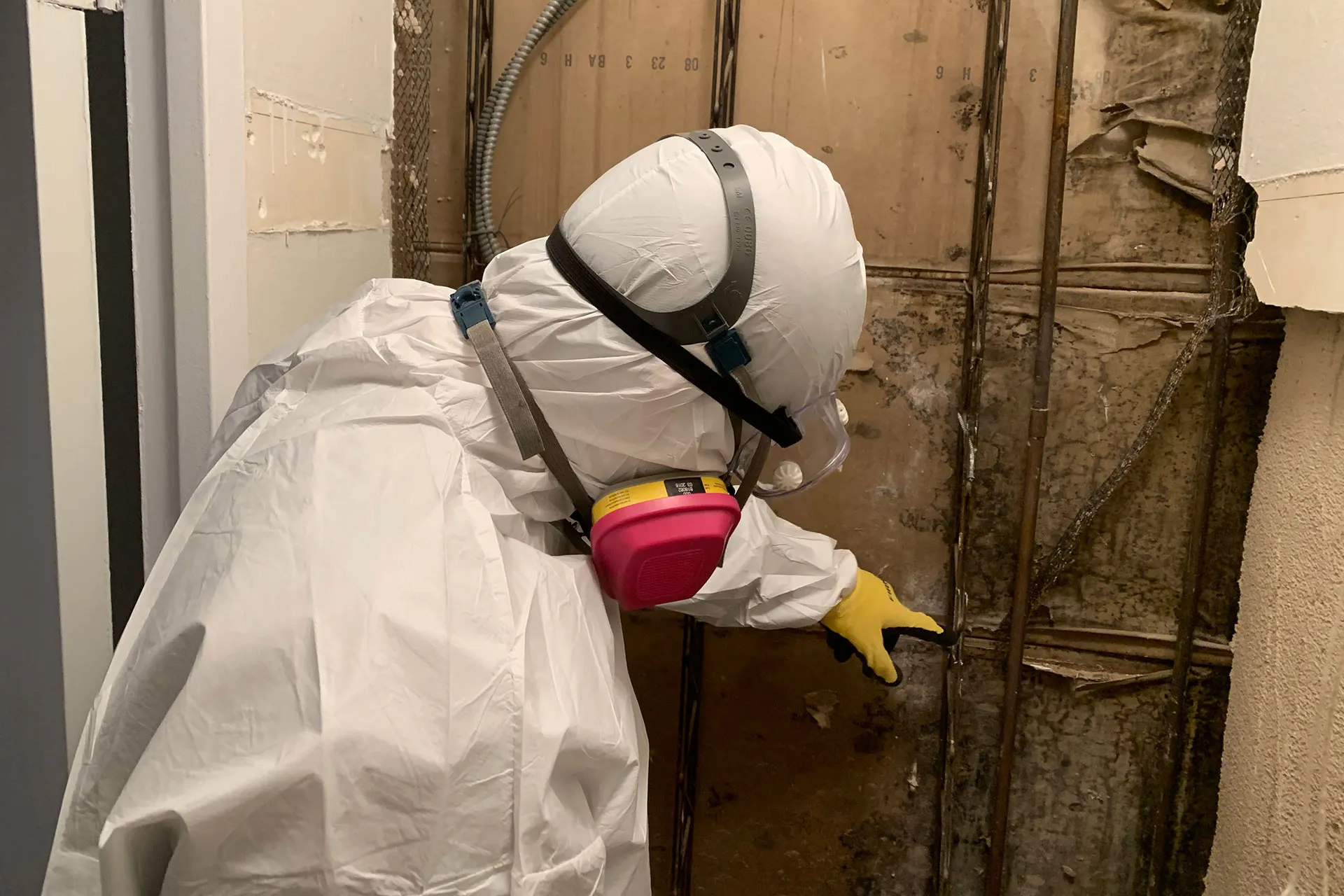
Before anything specific to contaminants or measurements, general liability answers the everyday third-party risk of doing your work inside somebody else’s building while they are still using it. Restoration especially: the loss did not happen at your shop, it happened at a house or a business, and your crew shows up to a structure that is occupied, damaged, and full of the owner’s finished surfaces and belongings. A homeowner, a tenant, a building occupant, a property manager, or a neighbor hurt while your crew is working — slipping on a wet floor near the air movers, tripping over a hose run down a hallway, struck by material during a tear-out — is a third-party bodily-injury claim, and general liability is built to respond to it and to the legal defense that comes with it.
The same is true of damage your work does to property that is not yours. Restoration and radon crews work in tight quarters around finished construction: a tool that gouges a hardwood floor, a ladder that punches a wall, a drying setup that a piece of the structure gets damaged around, or — on the radon side — a sub-slab penetration or a fan installation that cracks a slab, damages a foundation wall, or disturbs a finished basement. When your operation damages the occupied structure or its contents in a way that is not the contaminant you were hired to address, that third-party property damage is a general-liability matter. This is the premises-and-operations base both trades share; from here, the exposures fork.
The completed-operations tail: the rebuild and the radon system that fail later
General liability does not stop when your crew drives away. Both of these trades leave something behind that can cause a loss long after the job is closed, and that is what the completed-operations side of the policy answers. On the restoration side it is the rebuild: a reconstruction — drywall, flooring, cabinetry, structural repair — that develops a problem months later, where the finished work injures someone or damages property after the fact. On the radon side it is the installed system: a mitigation fan, a sealed membrane, or a sub-slab assembly that fails after the crew has left. Both are completed-operations exposures, and for a loss-driven rebuild in particular the tail can be long.
The standard commercial general liability policy answers this through what it calls the products-completed-operations hazard. In the standard ISO coverage form — the one most policies start from, typically the occurrence-based form known as CG 00 01 — that hazard is a defined term covering bodily injury and property damage arising out of your completed work after it has left your control. Because a job finished today can cause a loss months or years later, the trigger matters. The occurrence-based CG 00 01 responds to injury or damage that occurs during the policy period, no matter when the claim is finally made; the claims-made counterpart — the CG 00 02 form — responds instead based on when a claim is reported, and depends on continuous coverage and retroactive dates to reach a loss from an earlier job. For a restoration contractor with a real reconstruction tail, that difference is worth reading before a loss, not during one; editions vary by insurer, so the wording actually attached to your policy governs.
The two defining lines: what general liability does not answer
Here are the two seams that make restoration and radon specialty classes at all, and they are the reason two of the eight coverage lines exist. An operator who assumes general liability answers for everything finds these gaps during a claim. Read both slowly.
The pollutant you were hired to remove — the pollution exclusion. This is restoration’s spine. A standard general liability policy contains a pollution exclusion, and in restoration that exclusion reaches the exact substances the trade is hired to remove: mold, the sewage in a Category 3 water loss, and the smoke and soot residues after a fire, along with the contaminated material you transport and dispose of. The base policy, by its own terms, does not answer for the contaminant itself. That carve-out is not a hole to paper over; it is the reason a purpose-built line exists. Contractors pollution liability is written precisely to answer the environmental exposure general liability removes — and because contractors pollution forms are largely a manuscript, non-standard market, how one is written matters. We name the exclusion by function rather than by a clause number, because its specific letters vary by form and edition; what does not vary is the shape of it — the substance you were hired to remove is carved out of general liability, and contractors pollution liability is where it is answered.
The opinion someone relied on — workmanship versus judgment. This is radon’s spine, and it reaches the restoration side too. General liability answers workmanship: the physical harm of the work, the ladder that scratched the floor, the drill that hit a pipe. It does not answer judgment — the professional opinion your business is paid to produce. A radon measurement relied on at a real-estate closing that later reads high, a clearance test signed too early after a mold remediation, a protocol chosen for a measurement: when the loss is the opinion rather than the object, general liability does not respond. That exposure belongs to professional liability, the errors-and-omissions line — and there is no ISO form written for this class, so the honest thing is to say so rather than imply one. The line between the two is the line between the work of your hands and the judgment of your report.
Additional insured: the contracts and programs that require it
Restoration and radon work runs on other people’s contracts, and several kinds of them will demand additional-insured status on your general liability. A general contractor who hires you as a restoration or reconstruction subcontractor almost always requires it, so a claim arising from your work does not land solely on them. A property manager or facility owner whose occupied building your crew is working in wants the same for the operations you perform on their premises. And on the insurer-funded side of restoration, the program and third-party-administrator relationships that route work to a contractor frequently carry insurance and additional-insured requirements of their own — part of working within the claims process rather than advice about anyone’s claim.
Being named an additional insured means your policy extends a measure of its protection to that party for the work you do for them. Whether your policy adds these on a blanket basis — additional-insured status “where a written contract requires it” — rather than scheduling each general contractor, property manager, or program by name, and at what limits, depends on the endorsements actually attached to your policy, and their editions vary by insurance carrier. We describe the demand honestly and read the endorsements against your contracts before binding, rather than discovering a missing requirement when a certificate request lands on your desk.
Where general liability stops: the seams that matter
Some exposures look like they belong here and do not, and naming them honestly is the whole point — because an operator who assumes general liability answers for everything finds the gap during a claim. General liability covers the third-party harm your operation and your completed work can cause. Seven neighbors pick up where it stops, and the first two are the spines this brand is built on.
The contaminant seam — contractors pollution liability. General liability’s pollution exclusion removes the mold, Category 3 sewage, and smoke and soot residues your crew is hired to remove, along with the material you haul away. Those exposures are answered by contractors pollution liability, the line written for exactly what general liability carves out. General liability answers the harm you cause others; contractors pollution liability answers the substance you were hired to remove. It is the single most important line-drawing for the restoration side of this brand.
The judgment seam — professional liability. General liability answers workmanship; it does not answer the professional opinion your business is paid to produce. The radon number relied on at a closing, the clearance test signed, the protocol chosen — the exposure where the loss is the judgment, not the object — is a professional liability claim. General liability is the work of your hands; professional liability is the judgment of your report. It is the defining line for the radon side, and it reaches restoration wherever the work produces an opinion rather than a repair.
The contents seam — bailees coverage. A standard general liability policy also excludes damage to personal property in your care, custody, or control — and when you pack out a customer’s furniture, electronics, and documents and hold them at your storage facility or move them in your truck, those goods are exactly that. The customers’ contents general liability carves out are answered by bailees coverage, the line written for property that is not yours but is your responsibility while it is in your hands.
The your-own-gear seam — contractors equipment. General liability does not pay for your own property. Your dehumidifiers, air movers, air scrubbers, generators, and radon fans are your equipment, and a loss to the gear itself — deployed at a loss site, in transit, or stolen — is a first-party contractors equipment claim, not a liability one. The line is ownership: general liability answers third-party harm, contractors equipment answers your own tools.
The employee-injury seam — workers compensation. A technician hurt on the job — in a respirator in a contaminated attic, in a crawlspace on a sub-slab install, or on storm work at height — is your own employee, and that injury is a workers compensation claim, not a general-liability one. General liability answers third parties — the people who are not your crew. Workers compensation answers your crew, and in the four monopolistic state-fund states the coverage does not come from a carrier at all. The same event that is a general-liability matter when a visitor is hurt is a workers compensation matter when your own technician is.
The road seam — commercial auto. General liability answers the premises and the operations; it does not cover your vehicles. The trucks that roll on an emergency call, the trailers that haul drying equipment, and the box trucks that move a pack-out — the at-fault accident, the physical damage, the auto liability on the road — run through commercial auto, not general liability.
The excess seam — excess liability. General liability carries per-occurrence and aggregate limits; when a general contractor, a property manager, or a large-loss contract demands limits above your primary layer, that added height sits in an excess liability policy over this one. On this brand the form is excess, not umbrella, and the distinction is worth reading: an excess policy that says it follows form may still not follow the pollution or professional wording underneath it — which is precisely the gap that matters on a restoration or radon program, where those two lines carry the exposure. Excess adds limit; it does not quietly add coverage the underlying policies do not grant.
Why restoration and radon businesses need it
What makes this class distinctive is that general liability sits at the center of a program with several purpose-built neighbors, and getting the center right is what keeps the neighbors from being assumed. It is the line a general contractor and a property manager insist on before they let you work, and it is the base every specialty line on the program is drawn against.
Because the exposure differs by the operation, the policy has to fit it. A Restoration Contractor operation lives on the after-the-loss reality — occupied structures mid-crisis, a reconstruction tail, and the pollutant carved to contractors pollution liability and the contents carved to bailees coverage. A Radon Mitigation Business operation lives on the before-the-hazard reality — installs in occupied homes, a system that has to keep working, and the measurement carved to professional liability. Writing both off one generic form misprices the work. We rate each to the real operation.
What general liability responds to
These are the categories underwriters expect on a restoration or radon general liability file. They are described qualitatively and with generic carrier language — every claim is handled by the insurance carrier, never named here — with no fabricated cost or frequency figures.
- Premises and operations bodily injury. A homeowner, a building occupant, a property manager, or a passer-by injured while your crew works inside an occupied structure — a slip near the air movers, a trip over a hose run, or a struck-by during a tear-out.
- Third-party property damage. Damage your work does to property that is not yours and is not the contaminant — a gouged floor, a punctured wall, a cracked slab from a sub-slab penetration, or a finished surface harmed during the job.
- Completed-operations claims. Injury or property damage caused after the work is finished — a reconstruction that fails months after the rebuild, or a radon mitigation system that fails after installation — answered under the products-completed-operations hazard.
- Additional-insured and certificate obligations. The general-contractor, property-manager, and program requirements a general liability policy is written to satisfy, including additional-insured status where the contract demands it.
- Defense of third-party claims. The cost of defending a covered third-party bodily-injury or property-damage claim, which general liability answers alongside any indemnity.
Limits and structure
General liability is usually written with a per-occurrence limit and separate aggregates — the general aggregate for premises-and-operations claims and the products-completed-operations aggregate, the cap specific to completed-work claims, which is the piece a reconstruction-heavy restoration contractor and a radon business with an installed-system tail both watch. The right structure is driven by the operation: whether you are a mitigation-and-reconstruction restoration contractor, a measurement-and-mitigation radon business, or a mix; the reconstruction and install tail you carry; the general-contractor, property-manager, and program contracts on your books; and your claims history. Those contracts especially drive the additional-insured and certificate-of-insurance requirements, often demanding specified limits. Rather than quote a number, we read what your contracts demand and build the structure to satisfy them. Where a contract calls for limits above your primary layer, that is what excess liability is for; the contaminant you remove is answered by contractors pollution liability, the professional opinion behind a measurement by professional liability, and the customers’ contents in your care by bailees coverage, as separate lines.
Why Restoration Guard Insurance
We are an independent agency that writes one world — restoration and radon mitigation — and we place coverage with insurance carriers that actually want the work. That focus is the point. We know to ask whether you respond to water, fire, smoke, and mold losses, whether you rebuild what you mitigate, and whether you measure and mitigate radon, before we quote; to draw the pollution exclusion so the substance you remove is answered by contractors pollution liability rather than assumed into general liability; to draw the workmanship-versus-judgment line so a radon measurement is answered by professional liability; and to set additional-insured endorsements to match the general-contractor, property-manager, and program contracts you work under. When a certificate request lands on your desk with requirements you do not recognize, that is a call we take. Start with a quote, or talk it through with us first.
Learn more
Coverage for a restoration or radon business works as a system. General liability pairs most often with the two lines it carves out — contractors pollution liability for the mold, sewage, and smoke and soot it excludes, and professional liability for the measurement opinion it does not answer — plus bailees coverage for the customers’ contents in your care, contractors equipment for your drying and radon gear, workers compensation for the crew, commercial auto for the response fleet, and excess liability when a contract demands limits above your primary layer. How it is written also differs by the operation across the two service pillars — Restoration Contractor Insurance and Radon Mitigation Business Insurance.
The two lines general liability carves out
The rest of the program
- Contractors Equipment Insurance
- Workers Compensation Insurance
- Commercial Auto Insurance
- Excess Liability Insurance
Insurance by the operation you run
Get covered
Primary sources
Frequently asked questions about General Liability Insurance
What does general liability cover for a restoration or radon business?
General liability answers third-party bodily injury and property damage that arise from your operation — a homeowner, a building occupant, a property manager, or a passer-by hurt while your crew is working, and physical damage your work does to property that is not yours. Because both trades work inside occupied structures, that exposure is constant: a visitor who slips on a wet floor near your air movers, a tool that damages a finished surface, a sub-slab penetration that cracks a slab you did not mean to. It also answers the completed-operations tail — a rebuild or a radon system that causes injury or damage after the crew has left. It does NOT answer the pollutant you were hired to remove (that is contractors pollution liability), the professional opinion behind a radon measurement (professional liability), the customers’ contents in your care (bailees coverage), your own drying equipment (contractors equipment), your own crew’s injuries (workers compensation), or your trucks on the road (commercial auto).
Does general liability cover the mold, sewage, or smoke my crew is removing?
No — and this is the single most important thing to understand about a restoration contractor’s general liability. A standard general liability policy carries a pollution exclusion, and that exclusion reaches the very substances restoration exists to remove: mold, the sewage in a Category 3 water loss, and smoke and soot residues, along with the contaminated material you haul away. So the base policy does not answer for the contaminant itself. That is not a defect in your program to argue about at claim time; it is the reason a separate line exists. Contractors pollution liability is written precisely to answer the environmental exposure general liability carves out. This is about the coverage on your business, not advice to any property owner about their own loss.
If a radon measurement my business signed turns out wrong, does general liability respond?
Generally not — that is a professional-liability exposure, not a general-liability one. General liability answers workmanship and the physical harm of the work: the ladder that scratched a floor, the drill that hit a pipe. It does not answer the judgment your business is paid to produce — a radon number relied on at a real-estate closing, a clearance test signed after a mitigation, or a protocol chosen for a measurement. When the loss is the opinion rather than the object, it is professional liability, the errors-and-omissions line, that responds. There is no ISO form written for this class, so how that coverage is arranged is worth reading before a loss, not during one.
What is the completed-operations tail, and why does it matter for a rebuild or a radon install?
Completed operations is the part of general liability that answers injury or property damage caused by your work after it is finished and the crew has left. It matters here because both trades leave something behind that can fail later: a reconstruction that develops a problem months after the rebuild, or a radon mitigation system — a fan, sealed membrane, or sub-slab assembly — that fails after installation. The standard commercial general liability form, the occurrence-based CG 00 01, answers this through what it calls the products-completed-operations hazard, a defined term covering bodily injury and property damage arising out of your completed work. Because a job finished this year can cause a loss next year, the trigger matters: the occurrence form responds to injury or damage that occurs during the policy period no matter when the claim is made, while the claims-made counterpart, the CG 00 02 form, responds based on when the claim is reported and depends on retroactive dates and continuous coverage. The wording actually attached to your policy is what governs.
A general contractor or property manager requires me to add them as additional insured — what does that mean?
Restoration and radon work runs on other people’s contracts, and several of them will demand additional-insured status on your general liability. A general contractor who hires you as a restoration or reconstruction subcontractor, a property manager or facility owner whose building you are working in, and — on the insurer-funded side — the program and third-party-administrator agreements that route work to you can all require it. Being named an additional insured means your policy extends a measure of its protection to that party for the work you do for them. Whether your policy adds these on a blanket basis where a written contract requires it, and at what limits, depends on the endorsements actually attached — which is what we read against your contracts before binding, rather than discovering a missing requirement when a certificate request lands on your desk.
Does general liability cover my drying equipment, my crew, or my trucks?
None of the three — and each is a common point of confusion. Your dehumidifiers, air movers, air scrubbers, and radon fans are your own property, so a loss to the gear itself is contractors equipment (a first-party line), not general liability. An injury to your own technician — in a respirator in a contaminated attic, or in a crawlspace on a sub-slab job — is workers compensation, which answers your crew, while general liability answers only third parties. And your response trucks and pack-out vehicles run through commercial auto the moment a loss involves a vehicle on the road. One note on language: your insurance carrier is the company that writes your coverage, which is a different thing from a motor carrier that hauls freight for hire — we insure the fleet a restoration or radon business runs in service of its own work, not a for-hire trucking operation.
Get general liability built around where your work actually stops
Tell us whether you respond to losses, mitigate radon, or both, and we will market it to insurers that write the class — with the pollution and professional seams handled, not assumed.