

You hand a general liability certificate to every party that lets you onto a loss, and somewhere in all that handing over, it starts to feel like the policy that covers you. On a mold job, it is not. The standard general liability policy carries a pollution exclusion, and that exclusion reaches the mold you were hired to remove — which means the work that defines the trade sits outside the one policy everybody keeps asking you to prove.
This post is about the gap, not about the line that fills it. Contractors pollution liability is the answer, and its coverage page owns the architecture: how the grant is built, what a pollution condition turns on, how the tail works. What follows is narrower, and for most operators more useful — where the assumption comes from, why it survives as long as it does, and what it costs on the day it finally gets tested.
The policy everyone asks you to prove
The assumption has an origin, and it is not carelessness. It is the certificate.
Before a crew reaches a loss, somebody wants paper. The program wants a certificate. The third-party administrator wants a certificate. The property owner’s insurance carrier, the adjuster on the loss, the general contractor on the rebuild — all of them want to see that you carry general liability, usually at a limit they specify, often naming themselves as an additional insured. In an insurer-funded trade, the certificate is the credential. It is the document that gets you on the job.
Do that for a few years and something quiet happens. The paper that everyone treats as proof of your legitimacy becomes, in your own head, proof of your coverage. But look at what was actually asked. Nobody in that chain ever asked whether your general liability answers for the mold. They asked whether you carry it. Those are different questions, and only one of them ever gets asked out loud.
The day the assumption gets tested
A remediation goes wrong. Not spectacularly — they rarely do. Mold spreads past the containment into a clean part of the structure during demolition, or it comes back behind a wall you already signed off on, and the party who paid for the work wants to be made whole.
Now the claim is pointed at you. Not the property owner’s claim — that one has its own insurance carrier and its own scope of repair, and it is the environment you were working inside rather than anything for you to solve. This is a claim on your policy. And this is the moment the certificate you have been handing out for years stops functioning as an answer and starts functioning as a receipt: it establishes that you carry general liability, and general liability turns out not to be the thing being asked for.
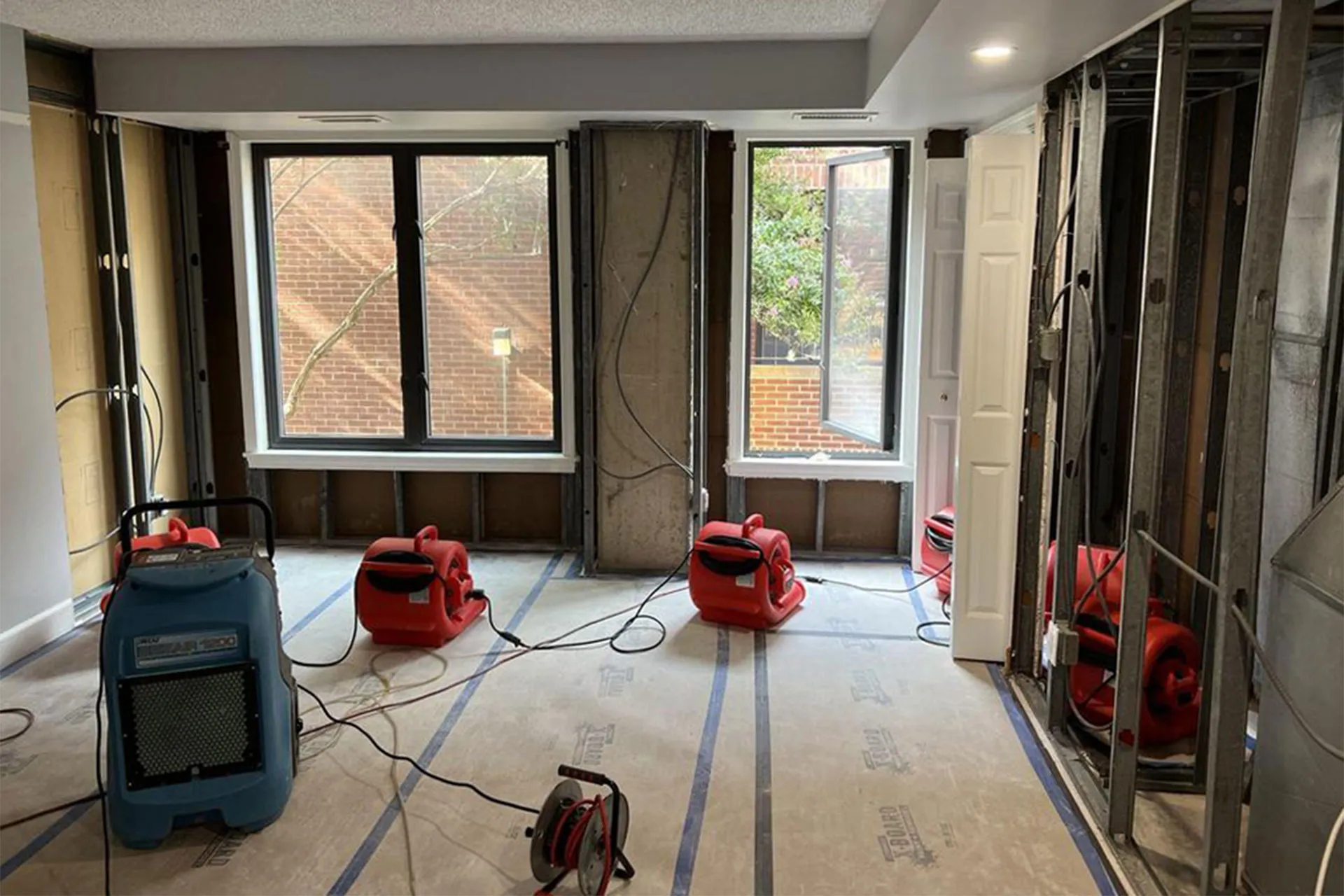
Real-World Scenario: A restoration company is brought in on a water loss with visible microbial growth in a finished basement. The crew builds containment, removes the affected material, and passes clearance. Weeks later, growth appears in an adjoining room that was clean when the work started, and the party who paid for the remediation brings a claim for the damage and the second round of removal. The company reports it to its general liability insurer, because general liability is the policy it has always carried and always been asked to prove. The base policy does not answer: the loss arises out of a contaminant, and the pollution exclusion removes it by the policy’s own terms. Nothing was mis-sold and nothing was hidden. The company was insured — for the harm it might cause someone in the course of the work, rather than for the substance it was hired to take away.
The word the policy uses for what you remove
The reason is one word, and it is carrying more weight than most operators realize.
The standard general liability form — the one most policies start from, typically the occurrence-based ISO form known as CG 00 01, though editions vary by insurer and plenty of specialty programs are written on manuscript wording that departs from it — excludes bodily injury and property damage arising out of the release or escape of a pollutant. Read that as a refinery problem and it sounds like somebody else’s exclusion.
It is not. The policy’s idea of a pollutant is not a list of industrial chemicals; it is written broadly, around irritants and contaminants. Mold is a contaminant. So is the sewage in a Category 3 water loss, and so are the smoke and soot residues after a fire. The exclusion does not care that the substance was the entire reason you were called. It only cares that the substance is what the loss is about.
That is the whole surprise, and the contractors pollution liability page takes it apart properly — the definitional reach, the two modes it shows up in, the disposal and transport exposure that follows the material off site. For this post, one consequence is enough: the base policy does not answer for the contaminant itself, and the contaminant is the job.
Why the assumption survives so long
Because almost nothing tests it.
You can run mold jobs for years and never file a claim on your own policy. The containment holds, the clearance passes, the invoice gets paid, and the next dispatch comes in. The exclusion sits in the form the entire time and never says a word — and the absence of a claim reads exactly like the presence of coverage.
That is not a failure of attention. It is what an exclusion is. A carve-out describes something that will not happen, so until it does not happen, there is genuinely nothing to see. It does not surface in renewals, it does not surface in certificates, and it will not surface in a clean year. The only way to find one early is to go looking for it deliberately, on an ordinary day, when nothing is on fire and nobody is waiting on an answer.
Not a defect, and not an argument worth having later
It is tempting to read all this as a policy that was written badly, or an insurance carrier being difficult. Neither is true, and believing either is expensive.
General liability is built to answer the harm you cause other people and their property out in the world. It was never built to sit behind the substance you were hired to handle. The pollution exclusion is not a hole in the policy — it is the edge of the policy, and the edge is precisely why a separate market exists at all. A form that answered for the contaminant in a contaminant-removal business would not be a general liability policy; it would be an environmental policy sold under the wrong name.
Which matters in a practical way. An exclusion is not a position you talk a carrier out of after a loss. It is the policy doing exactly what it says, and the argument you would be having is not one anybody is being unfair in winning. The time to disagree with a carve-out is while you can still buy your way around it.
The line built for what general liability removes
Contractors pollution liability is the line written to answer what general liability removes — the mold, the Category 3 sewage, the smoke and soot, the contaminated material that leaves the site on your truck.
One honest caution before you treat it as solved. Unlike general liability, it is largely a manuscript market: there is no single industry form to point at, which means how yours is worded is the whole question. Whether mold and microbial matter sit inside the grant, whether transport and disposal are covered, how a job you finished last year is treated — those vary by policy, and two contracts with the same words on the declarations can answer the same mold loss very differently. That is the pollution page’s ground, and it is worth the read.
<rect x="30" y="48" width="200" height="92" rx="9" fill="#ffffff" stroke="#DCC9B0"/>
<text x="130" y="76" text-anchor="middle" font-family="Inter, system-ui, -apple-system, 'Segoe UI', Roboto, sans-serif" font-size="14" font-weight="600" fill="#12703F">The certificate</text>
<text x="130" y="100" text-anchor="middle" font-family="Inter, system-ui, -apple-system, 'Segoe UI', Roboto, sans-serif" font-size="12" fill="#5A5048">Everyone asks you to prove</text>
<text x="130" y="118" text-anchor="middle" font-family="Inter, system-ui, -apple-system, 'Segoe UI', Roboto, sans-serif" font-size="12" fill="#5A5048">you carry general liability</text>

<rect x="250" y="48" width="200" height="92" rx="9" fill="#ffffff" stroke="#DCC9B0"/>
<text x="350" y="76" text-anchor="middle" font-family="Inter, system-ui, -apple-system, 'Segoe UI', Roboto, sans-serif" font-size="14" font-weight="600" fill="#12703F">The quiet years</text>
<text x="350" y="100" text-anchor="middle" font-family="Inter, system-ui, -apple-system, 'Segoe UI', Roboto, sans-serif" font-size="12" fill="#5A5048">Job after job, no claim —</text>
<text x="350" y="118" text-anchor="middle" font-family="Inter, system-ui, -apple-system, 'Segoe UI', Roboto, sans-serif" font-size="12" fill="#5A5048">the assumption looks proven</text>

<rect x="470" y="48" width="200" height="92" rx="9" fill="#ffffff" stroke="#DCC9B0"/>
<text x="570" y="76" text-anchor="middle" font-family="Inter, system-ui, -apple-system, 'Segoe UI', Roboto, sans-serif" font-size="14" font-weight="600" fill="#12703F">The mold claim</text>
<text x="570" y="100" text-anchor="middle" font-family="Inter, system-ui, -apple-system, 'Segoe UI', Roboto, sans-serif" font-size="12" fill="#5A5048">The policy steps aside from</text>
<text x="570" y="118" text-anchor="middle" font-family="Inter, system-ui, -apple-system, 'Segoe UI', Roboto, sans-serif" font-size="12" fill="#5A5048">the substance you removed</text>

<path d="M 232 94 L 246 94" fill="none" stroke="#12703F" stroke-width="2" marker-end="url(#gap-arrow)"/>
<path d="M 452 94 L 466 94" fill="none" stroke="#12703F" stroke-width="2" marker-end="url(#gap-arrow)"/>

<rect x="30" y="164" width="640" height="74" rx="10" fill="#C7683F" stroke="#12703F"/>
<text x="350" y="194" text-anchor="middle" font-family="Inter, system-ui, -apple-system, 'Segoe UI', Roboto, sans-serif" font-size="15" font-weight="600" fill="#1A1A1A">The gap: open since the first certificate you handed over</text>
<text x="350" y="218" text-anchor="middle" font-family="Inter, system-ui, -apple-system, 'Segoe UI', Roboto, sans-serif" font-size="13" fill="#1A1A1A">and invisible until a claim asks who answers for the mold</text>

<path d="M 350 240 L 350 266" fill="none" stroke="#12703F" stroke-width="2" marker-end="url(#gap-arrow)"/>

<rect x="110" y="272" width="480" height="72" rx="9" fill="#ffffff" stroke="#12703F"/>
<text x="350" y="300" text-anchor="middle" font-family="Inter, system-ui, -apple-system, 'Segoe UI', Roboto, sans-serif" font-size="15" font-weight="600" fill="#12703F">Contractors pollution liability</text>
<text x="350" y="324" text-anchor="middle" font-family="Inter, system-ui, -apple-system, 'Segoe UI', Roboto, sans-serif" font-size="13" fill="#5A5048">The line written for what general liability removes</text>

<text x="350" y="366" text-anchor="middle" font-family="Inter, system-ui, -apple-system, 'Segoe UI', Roboto, sans-serif" font-size="12" font-style="italic" fill="#5A5048">General liability still answers the harm you cause other people.</text>
<text x="350" y="384" text-anchor="middle" font-family="Inter, system-ui, -apple-system, 'Segoe UI', Roboto, sans-serif" font-size="12" font-style="italic" fill="#5A5048">That is a different job, not a broken one.</text>
The question that ends the assumption
Do not go hunting for a clause letter. The lettering moves between forms and editions, and you can find the paragraph, read it twice, and still not know what it means for the work your crews did last week. The function of the carve-out is stable even where its citation is not — which is why the useful question is functional, not textual.
Ask it of somebody who reads environmental exposures for a living, and ask it on an ordinary Tuesday:
- If mold spreads past containment on a job next month, which of my policies answers — and is it a policy I actually have?
- Is mold and microbial matter inside that policy’s grant, or carved back out of it?
- Does it follow the contaminated material after it leaves the site on my truck?
- Does it still answer for a remediation I finished last year?
Quick, specific answers mean the program is built. Vague answers are themselves the finding, and you have learned it on a day when nothing is burning.
The same reading is worth doing at the other places general liability stops, because pollution is not the only one. The professional opinion behind a clearance decision or a radon measurement is its own line with its own reasoning. So are the customers’ contents in your care during a pack-out. And if you carry excess above the program, whether it truly follows the pollution wording underneath it is a question worth asking before you need the answer.
Before the next mold job
The certificate is real, and it is doing real work — it is simply not doing the work you think it is doing on a mold loss. It proves you carry general liability. It has never once claimed that general liability answers for the contaminant you were hired to take out of somebody’s house.
The gap that leaves is not a mistake in your program. It is a line item missing from it, and closing it is ordinary work: contractors pollution liability, written against the mold, sewage, smoke, and soot you actually handle, and read carefully before a loss rather than urgently during one.
We build restoration contractor programs around that seam rather than around the certificate. If you want yours read against the work you actually do, ask us for a quote.