

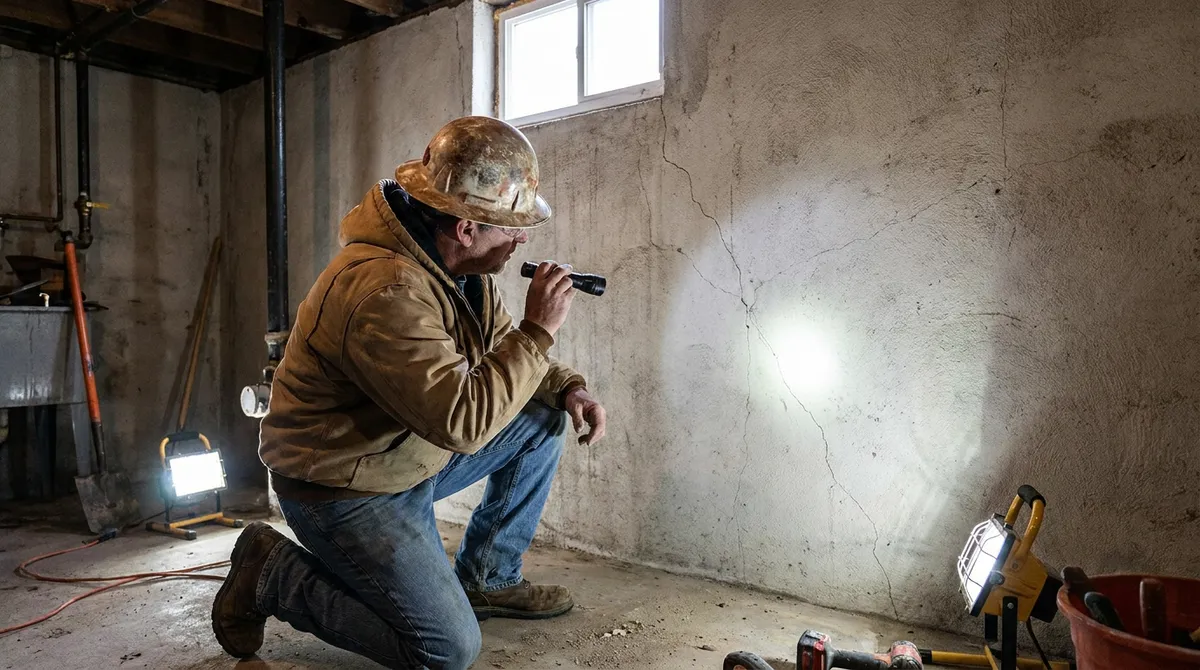
This post describes how state mold-remediation licensing regimes differ, at a high level. Those regimes change, they vary widely from one state to the next, and the specifics for any single state can turn on project size, project value, or the exact work you perform. Treat this as general education for business owners, not legal advice — before you rely on any of it, confirm your own state with the agency named for it and with counsel who can look at your actual operation.
An owner who has always worked in one state learns the answer to one question — am I licensed to remediate mold — and files it away as settled. Then the company grows. A storm pulls a crew across a state line. A program routes a water-and-mold job to a market the owner has never worked. And the question comes back, except now the answer that got filed away describes exactly one place. Cross the line and the question is not simply re-asked. The thing it is asking about has changed shape.
The word “licensed” does not travel
The instinct is to treat “licensed” as a portable status, like a driver’s license — earned once, recognized everywhere. Mold work is not built that way. There is no reciprocal national mold-remediation credential sitting above the states, so the verb owners reach for hides the fact that it points at a different object depending on where the crew is standing.
Read across a few states and the pattern is not a ladder from strict to loose. It is a set of genuinely different instruments. In some states the credential is a license the state issues. In another it is a registration, a name on a list. In another it does not exist as a mold credential at all until the job gets large, at which point a contractor classification switches on. In another the state issues nothing and instead requires you to hold a certification a private body grants. Same casual verb, different object underneath. “Am I licensed” turns out to be less one question than a separate question per state.
Where the state issues the credential itself
The most familiar arrangement is the one people picture when they say “licensed”: the state runs a program and hands out the credential directly.
Texas does this. The Department of Licensing and Regulation administers a Mold Assessors and Remediators program under Occupations Code Chapter 1958, and it licenses the assessor who writes the protocol and certifies clearance separately from the remediator who performs the work. Florida does it too, through the Department of Business and Professional Regulation, which licenses Mold Assessors and Mold Remediators as separate licenses under Chapter 468, Part XVI. New York goes further still, licensing Mold Assessors, Mold Remediation Contractors, and Mold Abatement Workers under Labor Law Article 32, with the regime reaching projects over ten square feet.
Notice what these have in common besides the word: a separation. Where a state issues the credential, it very often splits the roles so that the company saying what a building needs is not the company paid to do the removal on that same project. That separation is not a formality you paper over. It decides what kind of business you can be on a given job.
Where the state keeps a list instead
Move to a state that registers rather than licenses and the object changes.
Illinois requires mold remediators to register with the Department of Public Health under the Mold Remediation Registration Act, which took effect in January 2025, and to hold third-party certification and proof of financial responsibility to be on the list. Assessment, meanwhile, is unregulated there. So the state has decided to know who removes the mold while taking no formal view on who says it is present.
The difference between this and a license is not cosmetic. A registration records that you met stated entry conditions. A license is a permission with an examination and a practice regime behind it. An owner who tells a client, a general contractor, or an underwriter that the company is “licensed” in a state that in fact registers is not lying so much as describing the wrong object. The precise word matters here, because the thing behind it is precise.
Where a threshold switches the credential on
In some states the mold-specific credential is not the point of entry at all. The point of entry is a contractor classification, and it only appears once a job is big enough.
Tennessee works this way. There is no mold-assessor license and no stand-alone mold license. Instead, mold remediation above a project-value threshold falls under the Board for Licensing Contractors as an environmental specialty classification — a contractor trigger rather than a mold-practitioner credential. The credential you eventually need is a contractor’s, and whether you need it depends on the size of the work rather than on the fact that the work is mold. An operator who reads “no mold license” as “no requirement” has read only the first half of the sentence.
Where the state points at somebody else’s certificate
A fourth arrangement issues nothing at the state level and leans on a private certifying body instead.
Virginia runs no dedicated state mold license. A 2024 consumer-protection amendment instead mandates that a mold-remediation provider hold certification from a nationally recognized certifying body, and home-improvement remediation additionally requires a contractor license on top of that. The credential is entirely real; the state has simply chosen to make a private certification mandatory rather than to issue its own. For the owner, “the state does not license this” and “the state does not require anything” are two very different statements, and only the first one is true here.
Same crew, same work, different answer
Real-World Scenario: A restoration company builds a clean book in a state that licenses mold work. It holds the remediator credential, keeps the assessor role separate exactly as the state requires, and never has a problem. A program routes it a water-and-mold job two states away, and the owner — reasonably — assumes the credential travels with the crew. It does not. In the new state there is no license to hold; there is a registration the company is not on, or a mandated national certification that lapsed a year ago, or a contractor classification that switched on because this particular job is large. Nothing about the crew, the equipment, or the quality of the work changed between the two jobs. The credential question simply had a different answer in the second state, because it was pointing at a different object.
That scenario has no incompetence in it, which is exactly why it is worth planning for. The failure is not doing the work badly. The failure is assuming that a word that described one state described the country.
Checking your own state, and who actually answers
Because the object changes, the way you check has to change with it — and the agency you would ask is itself a clue to the kind of regime you are in. A department of licensing or professional regulation points toward a state-issued license. A health department often points toward a registration or a program. A board for licensing contractors points toward a classification that turns on the size or value of the job. Reading which agency owns the question is often the fastest way to understand what the question really is.
Two disciplines follow from that. First, read the current requirement rather than the one that was true when you last looked, because these regimes are amended — Illinois and Virginia both moved recently. Second, confirm the specifics against your actual work with counsel, since whether a threshold is crossed or a scope is covered is exactly the kind of question a general article cannot answer for your job. If you want the shape of your program read against the states you actually operate in, our restoration contractor coverage is built for exactly that cross-border reality.
<rect x="210" y="52" width="280" height="52" rx="9" fill="#F1E5D6" stroke="#DCC9B0"/>
<text x="350" y="76" text-anchor="middle" font-family="Inter, system-ui, -apple-system, 'Segoe UI', Roboto, sans-serif" font-size="13" font-weight="600" fill="#1A1A1A">Am I licensed to remediate mold?</text>
<text x="350" y="94" text-anchor="middle" font-family="Inter, system-ui, -apple-system, 'Segoe UI', Roboto, sans-serif" font-size="11" fill="#5A5048">Asked in one state, then asked again in the next</text>

<path d="M 350 106 L 350 122" fill="none" stroke="#12703F" stroke-width="2" marker-end="url(#mold-arrow)"/>

<rect x="22" y="128" width="156" height="96" rx="9" fill="#ffffff" stroke="#DCC9B0"/>
<text x="100" y="154" text-anchor="middle" font-family="Inter, system-ui, -apple-system, 'Segoe UI', Roboto, sans-serif" font-size="12" font-weight="600" fill="#12703F">A state license</text>
<text x="100" y="176" text-anchor="middle" font-family="Inter, system-ui, -apple-system, 'Segoe UI', Roboto, sans-serif" font-size="11" fill="#5A5048">The state issues</text>
<text x="100" y="192" text-anchor="middle" font-family="Inter, system-ui, -apple-system, 'Segoe UI', Roboto, sans-serif" font-size="11" fill="#5A5048">the credential,</text>
<text x="100" y="208" text-anchor="middle" font-family="Inter, system-ui, -apple-system, 'Segoe UI', Roboto, sans-serif" font-size="11" fill="#5A5048">often role-split</text>

<rect x="188" y="128" width="156" height="96" rx="9" fill="#ffffff" stroke="#DCC9B0"/>
<text x="266" y="154" text-anchor="middle" font-family="Inter, system-ui, -apple-system, 'Segoe UI', Roboto, sans-serif" font-size="12" font-weight="600" fill="#12703F">A registration</text>
<text x="266" y="176" text-anchor="middle" font-family="Inter, system-ui, -apple-system, 'Segoe UI', Roboto, sans-serif" font-size="11" fill="#5A5048">Your name on a</text>
<text x="266" y="192" text-anchor="middle" font-family="Inter, system-ui, -apple-system, 'Segoe UI', Roboto, sans-serif" font-size="11" fill="#5A5048">list the state</text>
<text x="266" y="208" text-anchor="middle" font-family="Inter, system-ui, -apple-system, 'Segoe UI', Roboto, sans-serif" font-size="11" fill="#5A5048">chooses to keep</text>

<rect x="354" y="128" width="156" height="96" rx="9" fill="#ffffff" stroke="#DCC9B0"/>
<text x="432" y="154" text-anchor="middle" font-family="Inter, system-ui, -apple-system, 'Segoe UI', Roboto, sans-serif" font-size="12" font-weight="600" fill="#12703F">A contractor trigger</text>
<text x="432" y="176" text-anchor="middle" font-family="Inter, system-ui, -apple-system, 'Segoe UI', Roboto, sans-serif" font-size="11" fill="#5A5048">A classification</text>
<text x="432" y="192" text-anchor="middle" font-family="Inter, system-ui, -apple-system, 'Segoe UI', Roboto, sans-serif" font-size="11" fill="#5A5048">that switches on</text>
<text x="432" y="208" text-anchor="middle" font-family="Inter, system-ui, -apple-system, 'Segoe UI', Roboto, sans-serif" font-size="11" fill="#5A5048">above a threshold</text>

<rect x="520" y="128" width="158" height="96" rx="9" fill="#ffffff" stroke="#DCC9B0"/>
<text x="599" y="154" text-anchor="middle" font-family="Inter, system-ui, -apple-system, 'Segoe UI', Roboto, sans-serif" font-size="12" font-weight="600" fill="#12703F">A mandate</text>
<text x="599" y="176" text-anchor="middle" font-family="Inter, system-ui, -apple-system, 'Segoe UI', Roboto, sans-serif" font-size="11" fill="#5A5048">Hold a private</text>
<text x="599" y="192" text-anchor="middle" font-family="Inter, system-ui, -apple-system, 'Segoe UI', Roboto, sans-serif" font-size="11" fill="#5A5048">certification the</text>
<text x="599" y="208" text-anchor="middle" font-family="Inter, system-ui, -apple-system, 'Segoe UI', Roboto, sans-serif" font-size="11" fill="#5A5048">state requires</text>

<rect x="30" y="248" width="640" height="72" rx="10" fill="#C7683F" stroke="#12703F"/>
<text x="350" y="278" text-anchor="middle" font-family="Inter, system-ui, -apple-system, 'Segoe UI', Roboto, sans-serif" font-size="15" font-weight="600" fill="#1A1A1A">Four different objects, one casual word</text>
<text x="350" y="302" text-anchor="middle" font-family="Inter, system-ui, -apple-system, 'Segoe UI', Roboto, sans-serif" font-size="12" fill="#1A1A1A">Not four grades of one credential — four things the word hides</text>

<path d="M 350 322 L 350 340" fill="none" stroke="#12703F" stroke-width="2" marker-end="url(#mold-arrow)"/>

<rect x="120" y="346" width="460" height="66" rx="9" fill="#ffffff" stroke="#12703F"/>
<text x="350" y="374" text-anchor="middle" font-family="Inter, system-ui, -apple-system, 'Segoe UI', Roboto, sans-serif" font-size="13" font-weight="600" fill="#12703F">Check each state before the crew crosses the line</text>
<text x="350" y="396" text-anchor="middle" font-family="Inter, system-ui, -apple-system, 'Segoe UI', Roboto, sans-serif" font-size="12" fill="#5A5048">Ask the agency that runs the regime, and confirm it with counsel.</text>Before you bid across a state line
The lesson is not that any one of these regimes is right or wrong. Each state made a defensible choice about how to know who is doing this work. The lesson is that the choices genuinely differ, so the answer you carry in your head describes the state you learned it in and no other.
So before the next out-of-state job, treat “am I licensed” as a live question rather than a settled one. Find the agency, read the current requirement, and check the specifics against your actual scope with counsel. If you want the insurance program underneath a business that works across those lines built for that reality rather than for one state, ask us for a quote.