

Indiana noticed something about this trade that most states have not bothered to articulate: the number does not come out of the device.
The Department of Health licenses radon testers in laboratory, primary, and secondary classes, and licenses radon mitigators, with national NRPP or NRSB certification as a prerequisite.
The laboratory class is the one worth stopping on. Most people — including most owners — picture radon measurement as a single act: a person, a device, a result. Indiana looked at that picture and saw distinct roles inside it, one of which is the analysis that turns what was collected into a number a household can be handed.
By licensing the laboratory separately, the state said that analysis is its own regulated act, with its own competence question, performed by its own accountable party. Which is more useful than it sounds — and no part of it produces a price, because the number still gets built from the operation.
The state followed the chain
Think about what has to be true for a client to receive a result.
Somebody decided where a device or a sample goes and why that location is representative. Somebody decided what conditions would be maintained while it sat there. Somebody collected it. Somebody analyzed it. And somebody interpreted what came back and put it in front of a household with a recommendation attached.
That is not one act. Indiana’s licensing structure says so out loud, and in doing that it exposes a question most operators have never put to themselves plainly:
When you hand a client a number, how much of it did you actually make?
Whose opinion is it, then?
The answer that matters legally is unambiguous, and it is worth being clear-eyed about.
Your client did not hire a laboratory. They hired you. They will rely on what you hand them, with your name on it.
So even where an analysis was performed by another licensed party, the judgment remains yours in every direction that counts: you chose that party. You collected what they analyzed. You decided the conditions under which it was collected. You interpreted and delivered the result.
A structure that separates the roles clarifies who did what. It does not divide up the reliance. The homeowner acted on your number, and a claim will say so.
What that means in practice
The practical version is unglamorous and it is the whole Indiana lesson: the chain has to be traceable, and you have to be able to describe it in sequence.
Which licensed party performed the analysis. What you provided them, in what condition. How it traveled. What came back, and what you did with it.
That reads like administration right up until a reading is contested — at which point the questions arrive in precisely that order, and an operator who can walk through the chain is in a fundamentally different position from one who says the result came from the lab.
Indiana has already told you the chain has links. Knowing which link did what is your part of the arrangement.
The reading is still the exposure
Which brings the program to its anchor.
A standard policy is built around general liability — the visitor who trips over your equipment, the property you damage by accident. Real; not definitive. What defines this trade is that you are paid to produce a number, and somebody makes a decision on it.
A device placed somewhere unrepresentative, conditions you did not control, a protocol chosen loosely, a clearance passing a house that should have failed, an analysis you relied on without knowing much about it — each is a claim about your judgment, and professional liability is what answers, not the general-liability line.
The license is an entry condition. It establishes that you met a standard and may perform the work. It says nothing about whether this measurement, in this house, on this day, was produced properly — the only question a claim ever asks. How much of your revenue rides on opinions people act on, and how disciplined the chain behind them is, sets your price.
Zone 1, frequency, and drift
Indiana sits predominantly in Zone 1, with large Zone 1 areas across the central and northern counties. Most houses are real candidates and an elevated result is unremarkable.
The quiet risk there is drift. When the answer feels known before you arrive, placement gets convenient rather than representative, and conditions go unrecorded because everyone already knows what the number will be. The contested file is never the house that read high in a Zone 1 county — it is the one that read differently from how it should have, on a day when nothing appeared to be at stake.
Instruments, crew, and the record
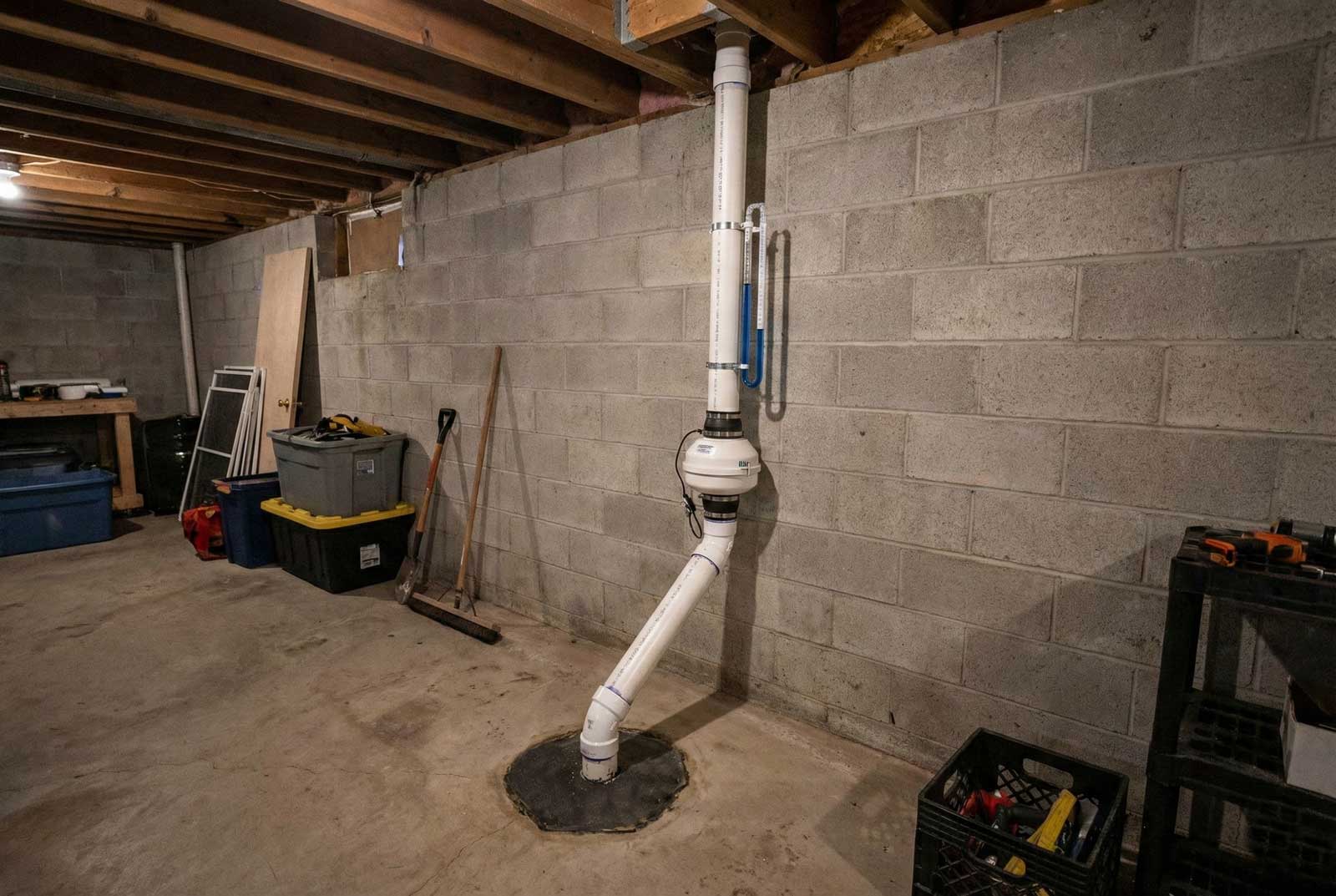
The equipment is modest and specific: continuous monitors, grab-sample devices, manometers and pressure gauges, and system materials. Contractors equipment schedules it for what it is worth and where it travels. Vehicles ride on commercial auto, and a vocabulary note this trade needs: an insurance carrier is the company writing your coverage, not a motor carrier hauling freight.
Where you install, the crew exposure is real: confined-space entry into crawlspaces and attics, coring through slab, pipe and fan in tight spaces. Workers compensation runs through a private, competitive market here, and the classifications should describe that work rather than the trade name.
Your loss record carries weight beyond its length, because a professional claim speaks to the judgment the business rests on. Limits and retention are the genuine choice: fund the small things and buy a serious professional and excess limit. Certification carries its own fees, incidentally; those are not insurance and we do not quote them.
How much of the number did you make?
<rect x="22" y="58" width="122" height="60" rx="8" fill="#ffffff" stroke="#DCC9B0"/>
<text x="83" y="82" text-anchor="middle" font-family="Inter, system-ui, -apple-system, 'Segoe UI', Roboto, sans-serif" font-size="11" font-weight="600" fill="#12703F">Placement</text>
<text x="83" y="100" text-anchor="middle" font-family="Inter, system-ui, -apple-system, 'Segoe UI', Roboto, sans-serif" font-size="9.5" fill="#5A5048">And why it is representative</text>

<path d="M148 88 L162 88" fill="none" stroke="#12703F" stroke-width="2"/>

<rect x="166" y="58" width="122" height="60" rx="8" fill="#ffffff" stroke="#DCC9B0"/>
<text x="227" y="82" text-anchor="middle" font-family="Inter, system-ui, -apple-system, 'Segoe UI', Roboto, sans-serif" font-size="11" font-weight="600" fill="#12703F">Conditions</text>
<text x="227" y="100" text-anchor="middle" font-family="Inter, system-ui, -apple-system, 'Segoe UI', Roboto, sans-serif" font-size="9.5" fill="#5A5048">Decided, and maintained</text>

<path d="M292 88 L306 88" fill="none" stroke="#12703F" stroke-width="2"/>

<rect x="310" y="58" width="80" height="60" rx="8" fill="#ffffff" stroke="#DCC9B0"/>
<text x="350" y="82" text-anchor="middle" font-family="Inter, system-ui, -apple-system, 'Segoe UI', Roboto, sans-serif" font-size="11" font-weight="600" fill="#12703F">Collection</text>
<text x="350" y="100" text-anchor="middle" font-family="Inter, system-ui, -apple-system, 'Segoe UI', Roboto, sans-serif" font-size="9.5" fill="#5A5048">By you</text>

<path d="M394 88 L408 88" fill="none" stroke="#12703F" stroke-width="2"/>

<rect x="412" y="58" width="122" height="60" rx="8" fill="#F1E5D6" stroke="#12703F"/>
<text x="473" y="82" text-anchor="middle" font-family="Inter, system-ui, -apple-system, 'Segoe UI', Roboto, sans-serif" font-size="11" font-weight="600" fill="#12703F">The analysis</text>
<text x="473" y="100" text-anchor="middle" font-family="Inter, system-ui, -apple-system, 'Segoe UI', Roboto, sans-serif" font-size="9.5" fill="#5A5048">A separately licensed party</text>

<path d="M538 88 L552 88" fill="none" stroke="#12703F" stroke-width="2"/>

<rect x="556" y="58" width="122" height="60" rx="8" fill="#ffffff" stroke="#DCC9B0"/>
<text x="617" y="82" text-anchor="middle" font-family="Inter, system-ui, -apple-system, 'Segoe UI', Roboto, sans-serif" font-size="11" font-weight="600" fill="#12703F">Interpretation</text>
<text x="617" y="100" text-anchor="middle" font-family="Inter, system-ui, -apple-system, 'Segoe UI', Roboto, sans-serif" font-size="9.5" fill="#5A5048">And your name on it</text>

<rect x="60" y="146" width="580" height="100" rx="9" fill="#C7683F" stroke="#12703F"/>
<text x="350" y="176" text-anchor="middle" font-family="Inter, system-ui, -apple-system, 'Segoe UI', Roboto, sans-serif" font-size="14.5" font-weight="600" fill="#1A1A1A">The client did not hire a laboratory</text>
<text x="350" y="200" text-anchor="middle" font-family="Inter, system-ui, -apple-system, 'Segoe UI', Roboto, sans-serif" font-size="12" font-weight="600" fill="#1A1A1A">Separating the roles clarifies who did what — it does not divide the reliance</text>
<text x="350" y="224" text-anchor="middle" font-family="Inter, system-ui, -apple-system, 'Segoe UI', Roboto, sans-serif" font-size="12" font-weight="600" fill="#1A1A1A">Professional liability answers across the whole chain</text>Indiana, in sum
The state did you a favor by making the chain explicit: it named the laboratory as its own licensed party, which means you have been told, in the statute, that the number you hand over is assembled rather than produced whole.
So know your chain and be able to walk it in order — who did which part, what you gave them, what came back. Because the license establishes that you may act, and every claim that matters is about one reading on one day, where the reliance was undivided and the name on it was yours.
For the coverage rather than the pricing, start with professional liability; the radon mitigation insurance program shows how it assembles, and the Indiana radon mitigation insurance page carries the state detail. For a figure built on your real operation, start a quote. And if you respond to water, fire, and mold losses rather than testing and mitigating radon, the restoration cost guide is your program.