

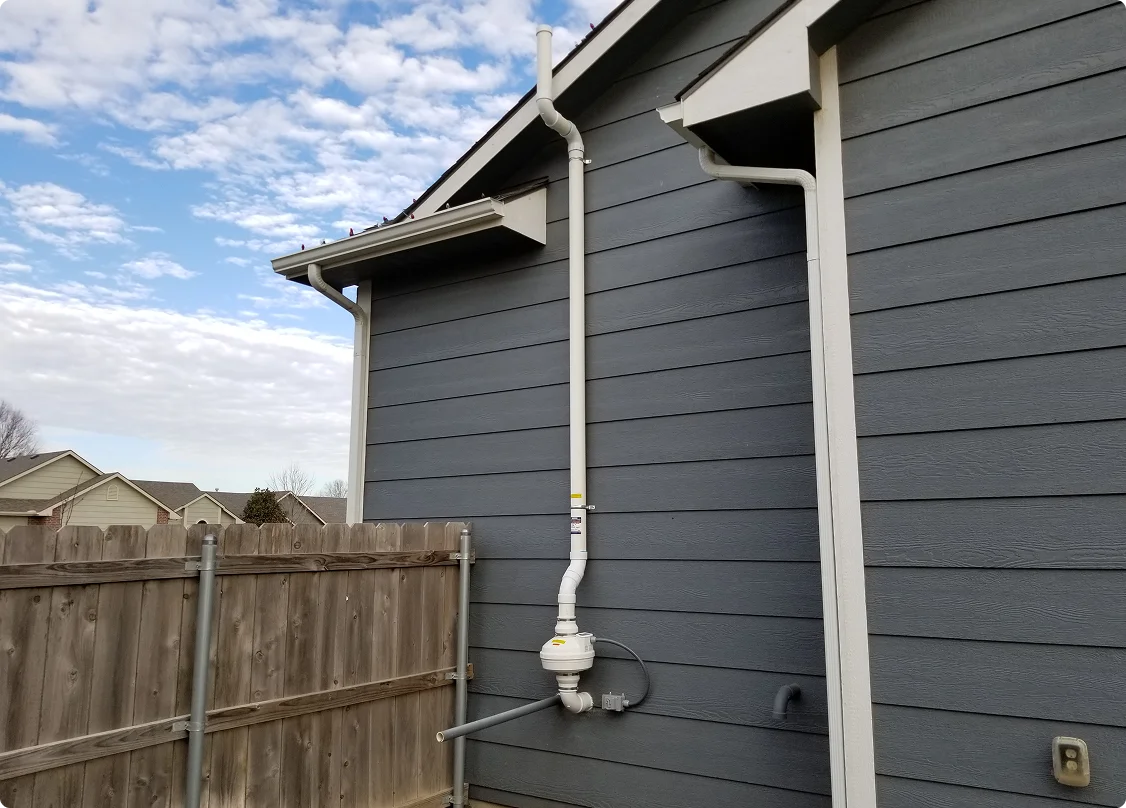
The Massachusetts building code requires radon-resistant new construction in the central Zone 1 counties. That is a real rule with real force, and it is worth reading closely — not for what it demands, but for what it never mentions.
It requires the system. It does not require anybody to find out whether the system worked.
There is no verification step. No measurement, no confirmation, no obligation on anyone to establish what the household is actually breathing. The code is prophylactic: it asks for a thing to be installed, and then the matter is closed as far as the code is concerned.
That gap is where a Massachusetts radon business lives, and it is a stranger place to stand than it first appears — which is part of why nobody produces a number for this trade from a table.
The code asks for a system and never asks whether it worked
Set out plainly, the sequence runs like this. A builder is obliged to install radon-resistant construction. They do. An inspector confirms the construction exists. It does. The house is sold.
At no point in that chain did anyone measure anything.
So a code-compliant house is precisely and only a house that complied. Whether the installed approach achieves what the occupants need is a question of fact, and the code did not ask it, so nobody answered it. The house is presumed fine on the strength of having the right hardware in the right place.
Presumption is not measurement. But it feels like it, to everybody who was in the room.
Selling into a settled question
That is the commercial problem, and it is a harder one than an open question.
A house with no system is an unknown, and unknowns invite testing. A house with a code-required system is, in the mind of its owner, already handled — the builder handled it, the code handled it, the inspector signed something. Suggesting a test sounds like suggesting the house has a problem it was specifically built not to have.
So you are not offering to answer an open question. You are offering to reopen a closed one. Everything about that conversation is more difficult, and it starts from a position of implied doubt about people who are not in the room.
What happens when you contradict a building code
And then sometimes the number comes back high.
Consider your position at that moment. The builder followed the requirement. The inspector signed. The buyer purchased on the understanding that this was dealt with. Your device says otherwise.
Every party in that chain now has an interest in your number being wrong — and the argument that follows is not about the pipe in the wall. It is about your instrument, your placement, your protocol, and your competence. A result that surprises everybody is, by some distance, the result most likely to be challenged.
You are not liable for telling the truth about a house. You are exposed if you cannot demonstrate how you arrived at it, in front of people motivated to find a gap.
Why that is a professional exposure
Which is the whole reason the program is shaped as it is.
A standard policy is built around general liability — the visitor who trips over your equipment, the property you damage by accident. Real; not definitive. What defines this trade is that you are paid to produce a number, and somebody makes a decision on it.
A device placed somewhere unrepresentative, conditions you did not control, a protocol chosen loosely, a clearance passing a house that should have failed — each is a claim about your judgment, and professional liability is what answers, not the general-liability line. In a code-compliant house that exposure is sharper rather than softer, because the surprising result is the contested one and the pressure lands on your methodology.
How much of your revenue rides on opinions people act on, and how disciplined the protocol behind them is, sets your price.
A standard for the house and none for you
Massachusetts issues no state radon license. The Department of Public Health recommends nationally certified professionals through NRPP or NRSB.
The asymmetry is worth naming. The state was willing to write a construction requirement into the building code for the central Zone 1 counties — a rule aimed squarely at the house. It was unwilling to say who is competent to measure the result.
The building has a standard. The person producing the number does not. So your scope, your protocol, and the certification you chose to carry are the entire benchmark, and they are read that way. Certification carries its own fees; not insurance, and not something we quote.
Where the readings sit, and what you carry
The map runs highest across the central and north-central counties — Worcester, Middlesex, and Essex — with the remainder of the state in the lower categories. Those central counties are where the code reaches, which is presumably why the line went there. They produce more elevated readings, more installations, and more code-compliant stock to form opinions about.
The equipment is modest and specific: continuous monitors, grab-sample devices, manometers and pressure gauges, and system materials, and contractors equipment schedules it for what it is worth and where it travels. Vehicles ride on commercial auto, where the vocabulary needs care: an insurance carrier writes your coverage; a motor carrier hauls freight for hire.
Where you install, the crew exposure is real — confined-space entry into crawlspaces and attics, coring through slab, pipe and fan in tight spaces. Workers compensation runs through a private, competitive market here, and the classifications should describe that work.
Your loss record carries weight beyond its length, because a professional claim speaks to the judgment the business rests on. Limits and retention are the genuine choice: fund the small things and buy a serious professional and excess limit.
A system is not an answer
<rect x="26" y="58" width="146" height="58" rx="8" fill="#ffffff" stroke="#DCC9B0"/>
<text x="99" y="82" text-anchor="middle" font-family="Inter, system-ui, -apple-system, 'Segoe UI', Roboto, sans-serif" font-size="11.5" font-weight="600" fill="#12703F">The builder</text>
<text x="99" y="100" text-anchor="middle" font-family="Inter, system-ui, -apple-system, 'Segoe UI', Roboto, sans-serif" font-size="10" fill="#5A5048">Installs what the code says</text>

<path d="M176 87 L194 87" fill="none" stroke="#12703F" stroke-width="2"/>

<rect x="198" y="58" width="146" height="58" rx="8" fill="#ffffff" stroke="#DCC9B0"/>
<text x="271" y="82" text-anchor="middle" font-family="Inter, system-ui, -apple-system, 'Segoe UI', Roboto, sans-serif" font-size="11.5" font-weight="600" fill="#12703F">The inspector</text>
<text x="271" y="100" text-anchor="middle" font-family="Inter, system-ui, -apple-system, 'Segoe UI', Roboto, sans-serif" font-size="10" fill="#5A5048">Confirms it exists</text>

<path d="M348 87 L366 87" fill="none" stroke="#12703F" stroke-width="2"/>

<rect x="370" y="58" width="146" height="58" rx="8" fill="#ffffff" stroke="#DCC9B0"/>
<text x="443" y="82" text-anchor="middle" font-family="Inter, system-ui, -apple-system, 'Segoe UI', Roboto, sans-serif" font-size="11.5" font-weight="600" fill="#12703F">The buyer</text>
<text x="443" y="100" text-anchor="middle" font-family="Inter, system-ui, -apple-system, 'Segoe UI', Roboto, sans-serif" font-size="10" fill="#5A5048">Purchases, matter closed</text>

<path d="M520 87 L538 87" fill="none" stroke="#12703F" stroke-width="2"/>

<rect x="542" y="58" width="132" height="58" rx="8" fill="#F1E5D6" stroke="#12703F"/>
<text x="608" y="82" text-anchor="middle" font-family="Inter, system-ui, -apple-system, 'Segoe UI', Roboto, sans-serif" font-size="11.5" font-weight="600" fill="#12703F">Presumed fine</text>
<text x="608" y="100" text-anchor="middle" font-family="Inter, system-ui, -apple-system, 'Segoe UI', Roboto, sans-serif" font-size="10" fill="#5A5048">On the strength of hardware</text>

<text x="350" y="140" text-anchor="middle" font-family="Inter, system-ui, -apple-system, 'Segoe UI', Roboto, sans-serif" font-size="11.5" font-style="italic" fill="#5A5048">At no point in that chain did anybody measure anything</text>

<rect x="60" y="158" width="580" height="98" rx="9" fill="#C7683F" stroke="#12703F"/>
<text x="350" y="186" text-anchor="middle" font-family="Inter, system-ui, -apple-system, 'Segoe UI', Roboto, sans-serif" font-size="14.5" font-weight="600" fill="#1A1A1A">Presumption is not measurement</text>
<text x="350" y="210" text-anchor="middle" font-family="Inter, system-ui, -apple-system, 'Segoe UI', Roboto, sans-serif" font-size="12" font-weight="600" fill="#1A1A1A">Your number is the first fact in the sequence — and it contradicts the rest of it</text>
<text x="350" y="234" text-anchor="middle" font-family="Inter, system-ui, -apple-system, 'Segoe UI', Roboto, sans-serif" font-size="12" font-weight="600" fill="#1A1A1A">Which is why the surprising result is the one that gets challenged</text>Massachusetts, in short
The code closed a question it never opened. It required hardware and asked nobody to check the outcome, which leaves you offering to reopen a matter your customer believes was handled by professionals before they ever met you.
And when your number disagrees with all of them, your methodology is what goes on trial rather than the house. So build the record on every job, not the interesting ones — calibration, placement with its reason, conditions including the obvious, and a report that says what it does not claim. You cannot know in advance which reading becomes the contested one.
For the coverage rather than the pricing, start with professional liability; the radon mitigation insurance program shows how it assembles, and the Massachusetts radon mitigation insurance page carries the state detail. For a figure built on your real operation, start a quote. And if you respond to water, fire, and mold losses rather than testing and mitigating radon, the restoration cost guide is your program.