

There is no published price for radon insurance in North Dakota, and any number quoted before an underwriter has looked at your work is a guess. What a carrier actually does is build the cost from your specific operation — and for a radon business, the input that moves the number most is not the fan on the wall or the truck in the driveway. It is the reading you produce.
Owners expect a conversation about hardware. It is not. A radon business is paid to produce a measurement — a reading with a figure attached — and someone makes a decision on that figure, most often at a closing. The exposure that defines the trade is not a pipe that leaks or a technician who trips; it is a professional judgment that turns out to be wrong. What follows are the drivers a carrier weighs, opening with the one that anchors the program.
The professional line, and the opinion behind the reading
This is the driver that anchors the program, and the one a generic contractor policy misses. A standard policy is built around general liability — the third party hurt on your jobsite, the property you damage by accident. Real, but not your defining exposure.
Your defining exposure is the reading. A monitor placed in the wrong location, a short-term test disturbed by an open window, a protocol chosen badly, a post-mitigation clearance that passes a home it should have failed — each is a claim about your judgment, and it is professional liability that answers for it. So the underwriting question is never “how many jobs do you run.” It is: how much of your revenue rides on measurement opinions other people rely on, and how disciplined is the protocol behind them?
Every county is Zone 1 — demand runs strong
North Dakota is not a state where radon is a rare concern. It is one of the most uniformly high-radon states in the country — every county sits in EPA Zone 1. There is no low-radon corner where testing is an occasional side service. That tends to mean fuller books, often with a real installation component, across Fargo, Bismarck, Grand Forks, and Minot.
Higher, steadier volume does not lower the per-reading exposure — each opinion is still relied upon at a closing — but it usually means a business with both a measurement side and a mitigation side, which brings the physical lines forward alongside the professional one. Demand on the testing side is still transaction-driven where it touches a sale.
No license — so the contract carries the weight
North Dakota issues no radon license. The Department of Environmental Quality runs an education program and endorses national NRPP or NRSB certification rather than credentialing. Where a state licenses radon work, that license sets a floor an underwriter can lean on when a claim lands. Here there is no floor written by the state, so the whole perimeter around a claim is your contract, your protocol, and the national certification you choose to carry. In an all-Zone-1 state with heavy volume, that agreement is doing load-bearing work, and an underwriter reads it closely.
Comp is different here — it comes only from the state fund
North Dakota adds a structural wrinkle no competitive-market state has, and it changes what a broker actually places for you.
North Dakota is a monopolistic workers-compensation state. Coverage comes only from Workforce Safety and Insurance, the state fund, and not from a private carrier — so workers compensation is not part of the commercial package placed privately. That does not make the injury exposure go away: mitigation still means confined-space entry into crawlspaces and attics, drilling and coring through a slab, and running pipe in tight, low spaces where a technician can be hurt. It just means your comp is arranged through the state fund while the rest of your program is placed privately. Keeping that account in good standing is part of a clean risk picture, even though it is not on the private policy.
Testing and installation: two exposures, one company
What you do shapes what you pay.
- Measurement-heavy work is almost purely a professional-opinion exposure: the device, the placement, the protocol, the clearance call.
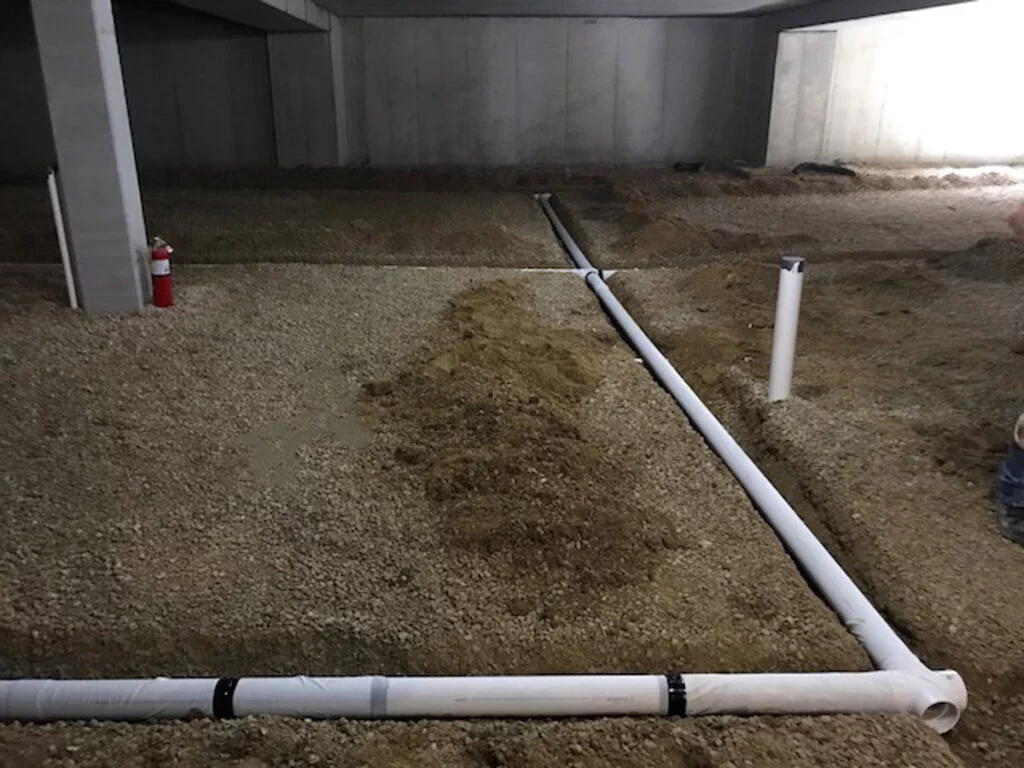
- Installation-heavy work — common in an all-Zone-1 state — adds a physical dimension: sub-slab depressurization, coring and sealing, and running pipe and a fan through an occupied home, bringing general liability and equipment forward alongside the professional line.
Equipment, fleet, limits, and claims
The equipment is modest but specific: continuous monitors, grab-sample devices, manometers and pressure gauges, and the fans and materials for a system. Contractors equipment schedules it for what it is worth and where it travels across a large, spread-out state.
The fleet is usually light — service vehicles carrying instruments and materials — though the distances between markets make commercial auto a real line. Worth one point of language: your insurance carrier is the company that writes your coverage, a different thing from a motor carrier that hauls freight. Your loss record carries real weight — a professional-liability claim reads far louder than a fender-bender. Limits and retention are a genuine choice against the professional and excess limits you cannot be short on. With comp placed through the state fund, the private program concentrates on exactly these lines.
A market spread thin
North Dakota’s market is spread thin across a wide state — Fargo and West Fargo in the east, Bismarck and Mandan in the center, Grand Forks and Minot to the north. Because every county sits in the top radon zone, demand is steady everywhere rather than pocketed, so a book here usually blends measurement and installation, with the fleet and equipment schedule carrying the long distances between markets. An underwriter reads that as a fuller, more even book than a low-zone state produces — one where the professional line and the installation lines both stay busy, and only the comp piece steps out of the private package to the state fund.
What an underwriter is actually weighing
<rect x="36" y="70" width="180" height="150" rx="10" fill="#F1E5D6" stroke="#12703F"/>
<text x="126" y="132" text-anchor="middle" font-family="Inter, system-ui, -apple-system, 'Segoe UI', Roboto, sans-serif" font-size="13" font-weight="600" fill="#12703F">Every county in</text>
<text x="126" y="152" text-anchor="middle" font-family="Inter, system-ui, -apple-system, 'Segoe UI', Roboto, sans-serif" font-size="13" font-weight="600" fill="#12703F">the top zone</text>
<text x="126" y="176" text-anchor="middle" font-family="Inter, system-ui, -apple-system, 'Segoe UI', Roboto, sans-serif" font-size="11" fill="#5A5048">strong, steady demand</text>

<path d="M216 145 L262 145" fill="none" stroke="#12703F" stroke-width="2.5"/>
<path d="M254 138 L264 145 L254 152" fill="none" stroke="#12703F" stroke-width="2.5"/>

<rect x="268" y="70" width="240" height="150" rx="10" fill="#C7683F" stroke="#12703F"/>
<text x="388" y="122" text-anchor="middle" font-family="Inter, system-ui, -apple-system, 'Segoe UI', Roboto, sans-serif" font-size="14" font-weight="600" fill="#1A1A1A">The professional line</text>
<text x="388" y="146" text-anchor="middle" font-family="Inter, system-ui, -apple-system, 'Segoe UI', Roboto, sans-serif" font-size="11" fill="#1A1A1A">The reading someone relies on</text>
<text x="388" y="176" text-anchor="middle" font-family="Inter, system-ui, -apple-system, 'Segoe UI', Roboto, sans-serif" font-size="11" fill="#1A1A1A">Placed with GL, equipment,</text>
<text x="388" y="192" text-anchor="middle" font-family="Inter, system-ui, -apple-system, 'Segoe UI', Roboto, sans-serif" font-size="11" fill="#1A1A1A">and auto in the private package</text>

<rect x="536" y="86" width="132" height="118" rx="10" fill="#ffffff" stroke="#DCC9B0" stroke-dasharray="6 5"/>
<text x="602" y="128" text-anchor="middle" font-family="Inter, system-ui, -apple-system, 'Segoe UI', Roboto, sans-serif" font-size="12" font-weight="600" fill="#12703F">Workers comp</text>
<text x="602" y="152" text-anchor="middle" font-family="Inter, system-ui, -apple-system, 'Segoe UI', Roboto, sans-serif" font-size="10.5" fill="#5A5048">only the state</text>
<text x="602" y="167" text-anchor="middle" font-family="Inter, system-ui, -apple-system, 'Segoe UI', Roboto, sans-serif" font-size="10.5" fill="#5A5048">fund — outside</text>
<text x="602" y="182" text-anchor="middle" font-family="Inter, system-ui, -apple-system, 'Segoe UI', Roboto, sans-serif" font-size="10.5" fill="#5A5048">the package</text>

<text x="350" y="286" text-anchor="middle" font-family="Inter, system-ui, -apple-system, 'Segoe UI', Roboto, sans-serif" font-size="12.5" fill="#5A5048">The injury exposure is real — it just sits with the state fund.</text>
<text x="350" y="316" text-anchor="middle" font-family="Inter, system-ui, -apple-system, 'Segoe UI', Roboto, sans-serif" font-size="12.5" fill="#5A5048">The private program concentrates on the professional line.</text>
<text x="350" y="352" text-anchor="middle" font-family="Inter, system-ui, -apple-system, 'Segoe UI', Roboto, sans-serif" font-size="12" font-style="italic" fill="#5A5048">None of this is a price — it is how one gets built.</text>The honest summary
A North Dakota radon business is priced on judgment, not on hardware. The fans matter, the crew matters, the trucks matter — but the thing that moves the number most is the reading you produce and the opinion behind it, underwritten in an all-Zone-1 state that licenses no one and places comp only through the state fund, so your contract and your professional line carry the weight a credential carries elsewhere.
If you want to see how the coverage itself works rather than what it costs, start with professional liability — the line this whole conversation is really about — or step back to the radon mitigation insurance program and the full North Dakota radon mitigation insurance page. When you are ready for a number built on your real operation, start a quote. And if you respond to water, fire, and mold losses rather than test and mitigate radon, none of the above is your program: you want the restoration cost guide instead.