

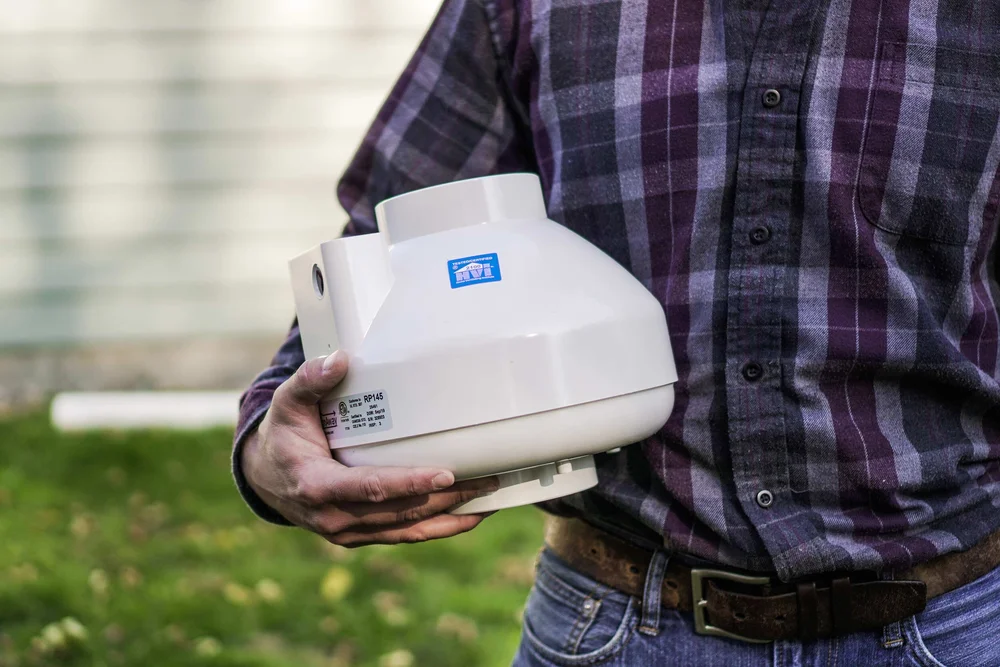
Strip a Tennessee radon business down to what it actually sells and you arrive at a single object. Not the fan, not the pipe, not the truck. A monitor.
The monitor produces a number. The number becomes an opinion with your name on it. The opinion becomes the thing a buyer, a seller, or a lender acts on at a closing. And if that chain is ever tested — if somebody asks how you knew — the device and its history are the only physical witnesses you have to call.
That is a strange position for a piece of equipment that costs a fraction of your truck. It is also why nobody can quote this trade from a table: the price is built from how the operation actually behaves, and here the operation runs through a machine.
The machine is the only witness
A continuous monitor and a grab-sample device answer different questions and carry different assumptions about duration and conditions. Choosing between them is a protocol decision, not a purchasing one.
When a claim arrives, it asks a narrow question: why that device, on that house, on that day. The answer has to be a reason. A habit is not a reason, and a habit is what most people actually have — the device that was in the van, the one they always use, the one that was charged.
Owners routinely over-think the fan and under-think the machine that determined whether the fan was needed at all. The fan is visible, physical, and easy to argue about. The machine made the call.
Calibration is a chain, not a certificate
The instinct is to treat calibration as a document — a certificate in a folder, produced when asked. That is not what carries weight.
What carries weight is an unbroken history, one that shows the instrument was in a known condition on the specific day it produced the reading now in dispute. A single certificate proves one moment. A history proves a practice, and a practice is what an underwriter is trying to price.
It is also, bluntly, the cheapest credibility available in this business. Nothing else in the file costs so little and speaks so directly to the question a contested claim actually asks.
And it answers the hardest version of that question too. If the device malfunctioned, the claim is still yours — the homeowner did not buy a device reading, they bought your opinion, and you chose the instrument, sited it, ran it under conditions you selected, and interpreted the output. A malfunction does not move the judgment anywhere. What the maintenance record establishes is whether the failure happened despite a disciplined process or inside a process nobody was running.
From device to opinion, and where liability attaches
Which is the whole reason the program is shaped the way it is.
A standard policy is built around general liability — the visitor who trips over your gear, the property you damage by accident. Real exposures, not defining ones. What defines this trade is that you are paid to produce a number and somebody makes a decision on it.
When the number does not hold up, the claim is about your judgment, and professional liability answers for it rather than the general-liability line. Follow the chain and every link is a judgment: which device, where it sat, what conditions were maintained, which protocol applied, what the result meant. The hardware is the only part of that chain that leaves physical evidence. How much of your revenue rides on opinions people act on, and how disciplined the chain behind them is, sets your price more than anything else here.
Three Tennessees, one instrument
The demand spreads unevenly. EPA radon zones run highest across East Tennessee around Knoxville and Chattanooga, moderate through Nashville and the middle, and lowest across the west toward Memphis. An east-side book finds elevated readings more often and installs more systems; a western book runs proportionally more measurement.
The instrument does not care. Both books rest on the same chain, and the low reading is relied on every bit as hard as the high one — it is the result that lets a transaction close with nothing further done.
The state that certifies nobody
Tennessee issues no state radon license. The Department of Environment and Conservation runs a radon program and recognizes national NRPP or NRSB certification.
That lands directly on the instrument question. Where a state licenses radon work, the license commonly publishes requirements about devices, placement, and conditions, and a claim is measured against the state’s document. Tennessee publishes none — so how your device is chosen, sited, and maintained is governed entirely by your protocol and the certification you carry.
The state has left the specification of your only physical evidence to you. Certification carries its own fees; that is not insurance and we do not quote it.
The install side, the crew, the record
Where you install, the work is physical: sub-slab depressurization systems, coring and sealing, pipe and fan run through occupied homes. Contractors equipment schedules the monitors, grab-sample devices, manometers, gauges, and system materials for what they are worth and where they travel — precise instruments rather than a heavy fleet. Vehicles ride on commercial auto, and a vocabulary note this trade needs: an insurance carrier is the company writing your coverage, not a motor carrier hauling freight.
The crew exposure is the understated one — confined-space entry into crawlspaces and attics, drilling through slab, pipe in tight spaces where someone can be hurt. Workers compensation runs through a private, competitive market here, and the classifications should describe that work rather than the trade name.
Your loss record carries weight beyond its length, because a professional claim on it speaks to the judgment the business rests on. Limits and retention are the genuine choice: fund the small things and buy a serious professional and excess limit.
The chain from machine to opinion
<rect x="26" y="56" width="118" height="56" rx="8" fill="#F1E5D6" stroke="#12703F"/>
<text x="85" y="80" text-anchor="middle" font-family="Inter, system-ui, -apple-system, 'Segoe UI', Roboto, sans-serif" font-size="11.5" font-weight="600" fill="#12703F">The device</text>
<text x="85" y="97" text-anchor="middle" font-family="Inter, system-ui, -apple-system, 'Segoe UI', Roboto, sans-serif" font-size="10" fill="#5A5048">Chosen, not defaulted</text>

<path d="M148 84 L164 84" fill="none" stroke="#12703F" stroke-width="2"/>

<rect x="168" y="56" width="118" height="56" rx="8" fill="#F1E5D6" stroke="#12703F"/>
<text x="227" y="80" text-anchor="middle" font-family="Inter, system-ui, -apple-system, 'Segoe UI', Roboto, sans-serif" font-size="11.5" font-weight="600" fill="#12703F">Calibration</text>
<text x="227" y="97" text-anchor="middle" font-family="Inter, system-ui, -apple-system, 'Segoe UI', Roboto, sans-serif" font-size="10" fill="#5A5048">A chain, not a page</text>

<path d="M290 84 L306 84" fill="none" stroke="#12703F" stroke-width="2"/>

<rect x="310" y="56" width="118" height="56" rx="8" fill="#ffffff" stroke="#DCC9B0"/>
<text x="369" y="80" text-anchor="middle" font-family="Inter, system-ui, -apple-system, 'Segoe UI', Roboto, sans-serif" font-size="11.5" font-weight="600" fill="#12703F">Placement</text>
<text x="369" y="97" text-anchor="middle" font-family="Inter, system-ui, -apple-system, 'Segoe UI', Roboto, sans-serif" font-size="10" fill="#5A5048">Representative, or handy</text>

<path d="M432 84 L448 84" fill="none" stroke="#12703F" stroke-width="2"/>

<rect x="452" y="56" width="118" height="56" rx="8" fill="#ffffff" stroke="#DCC9B0"/>
<text x="511" y="80" text-anchor="middle" font-family="Inter, system-ui, -apple-system, 'Segoe UI', Roboto, sans-serif" font-size="11.5" font-weight="600" fill="#12703F">Conditions</text>
<text x="511" y="97" text-anchor="middle" font-family="Inter, system-ui, -apple-system, 'Segoe UI', Roboto, sans-serif" font-size="10" fill="#5A5048">Held, and recorded</text>

<path d="M574 84 L590 84" fill="none" stroke="#12703F" stroke-width="2"/>

<rect x="594" y="56" width="80" height="56" rx="8" fill="#ffffff" stroke="#DCC9B0"/>
<text x="634" y="80" text-anchor="middle" font-family="Inter, system-ui, -apple-system, 'Segoe UI', Roboto, sans-serif" font-size="11.5" font-weight="600" fill="#12703F">The number</text>
<text x="634" y="97" text-anchor="middle" font-family="Inter, system-ui, -apple-system, 'Segoe UI', Roboto, sans-serif" font-size="10" fill="#5A5048">Produced</text>

<path d="M350 118 L350 138" fill="none" stroke="#12703F" stroke-width="2"/>

<rect x="70" y="144" width="560" height="60" rx="9" fill="#C7683F" stroke="#12703F"/>
<text x="350" y="170" text-anchor="middle" font-family="Inter, system-ui, -apple-system, 'Segoe UI', Roboto, sans-serif" font-size="14" font-weight="600" fill="#1A1A1A">The opinion somebody relies on</text>
<text x="350" y="191" text-anchor="middle" font-family="Inter, system-ui, -apple-system, 'Segoe UI', Roboto, sans-serif" font-size="11.5" font-weight="600" fill="#1A1A1A">Professional liability answers here — not the general-liability line</text>

<text x="350" y="230" text-anchor="middle" font-family="Inter, system-ui, -apple-system, 'Segoe UI', Roboto, sans-serif" font-size="11" font-style="italic" fill="#5A5048">No state standard governs any link. The device is the only one that leaves a record.</text>
The residue
The most valuable thing in a Tennessee radon submission costs less than a set of tyres. Keep the calibration history unbroken. Record why each device went where it went. Those two habits answer the exact questions a contested file asks, and they are close to free.
Everything else follows from the same fact: you sell a judgment that runs through a machine, in a state that has written no rule about the machine, the placement, or the conditions. Your protocol is the rule.
For the coverage rather than the pricing, start with professional liability; the radon mitigation insurance program shows how the pieces assemble, and the Tennessee radon mitigation insurance page carries the state detail. For a figure built on your real operation, start a quote. If you respond to water, fire, and mold losses rather than testing and mitigating radon, read the restoration cost guide instead.