

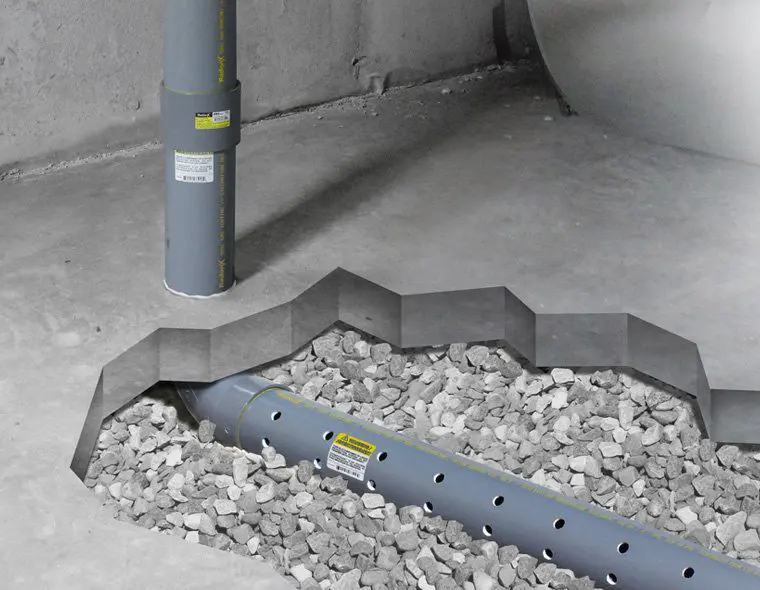
There is a version of radon work that sounds almost administrative. Devices, readings, reports, a certificate at the end. Anyone who has installed a system in a Wisconsin basement in February knows that version does not exist.
The real thing involves a person on their back in a crawlspace that was built for access rather than occupancy, drilling and coring through a slab, and running pipe and a fan through a house where a family is having dinner upstairs. Wisconsin keeps that work indoors and constant — older housing stock, deep basements, and a winter that does not encourage anybody to work outside.
That exposure is genuine, it is understated more often than any other item on a radon submission, and it is not what sets your price. Both halves of that sentence matter, and neither is available from a rate table.
The part of the job with a person in it
Confined space, dust, and drilling is an unusual combination. Most trades meet one of those at a time; a mitigation crew meets all three on the same afternoon.
The injuries are not exotic. Strains from working in postures nobody would choose. Falls on stairs and ladders in tight houses. Cuts. Respiratory irritation from slab dust. Occasionally something worse. What makes them matter is that they are ordinary — ordinary means frequent, and frequency is what an underwriter reads.
None of it is dramatic enough to feel like a risk while you are doing it, which is precisely the problem.
What the classification is supposed to describe
Which leads to the error owners make most often, almost always without meaning to.
From the outside — and on a spreadsheet — a radon business can look like a testing operation. Testing operations classify light. A light payroll looks efficient.
But a technician coring a slab in a Madison basement is not in the same injury class as one placing a monitor and driving away, and neither of them belongs in the class of whoever writes the report. Workers compensation runs through Wisconsin’s private, competitive market, and it scales with payroll — while the classifications carry as much weight as the figure, because they are what the figure is supposed to mean.
Classifying honestly is not a route to paying less. It is how you are quoted accurately, and how you avoid an audit that resets the number after the fact.
The exposure that still sets the price
Now the distinction that reorders everything above.
A standard policy is built around general liability — the visitor who trips over your equipment, the property you damage by accident. Real, but not definitive. What defines this trade is that you are paid to produce a number, and somebody makes a decision on it.
The two exposures have different shapes. A technician injury is serious, bounded, and understood — comp exists because that category of loss is predictable enough to insure as a matter of routine. A wrong reading has no comparable boundary. It reaches a household that acted on what you told them, it surfaces late, and it argues about judgment rather than about events people watched happen.
A device placed somewhere unrepresentative, a protocol chosen loosely, a clearance passing a house that should have failed — each is a claim about your opinion, and professional liability is what answers, not the general-liability line. That is why the reading rather than the crawlspace sets your price, however much the crawlspace dominates your week.
Where Wisconsin’s readings actually are
The EPA radon map runs predominantly Zone 2 across the state, with extensive Zone 1 through the south-central and southwestern counties around Dane, and no Zone 3 anywhere at all.
So the southern half carries the higher potential, and an installation-heavier book tends to follow it — which loops straight back to the crew, because installation is where the bodies go into the crawlspaces. The rest of the state runs moderate.
Two cautions. A zone describes geological potential across an area and predicts nothing dependable about any individual address — which is exactly why somebody hires you rather than reading a map. And moderate is not light: a Zone 2 county contains houses that read high, and the reading relied upon is yours regardless of the color on the county.
No license, and what that does to the crew question
Wisconsin issues no state radon license. The Department of Health Services recommends professionals certified through national NRPP or NRSB.
The consequence people miss is that this reaches the physical work too. In a licensing state, the credential usually brings training requirements and practice standards along with it, and those touch how the installation is performed as well as how the measurement is taken. Wisconsin brings none of that machinery.
So your training records, your confined-space procedure, and your protocol are the entire standard — for the technician under the floor as much as for the number on the report. Certification carries its own fees; that is not insurance and we do not quote it.
Instruments, vehicles, and the record
The equipment is modest and specific: continuous monitors, grab-sample devices, manometers and pressure gauges, and the materials for a system. Contractors equipment schedules it for what it is worth and where it travels — precise instruments rather than a heavy fleet. Vehicles ride on commercial auto, and one point of vocabulary this trade collides with: an insurance carrier is the company writing your coverage, a different thing entirely from a motor carrier hauling freight.
Your loss record carries weight beyond its length, because a professional claim on it speaks to the judgment the business rests on. Limits and retention are the genuine choice: fund the small things and buy a serious professional and excess limit you cannot afford to be short on.
Two exposures, and who is at the other end
<rect x="30" y="54" width="300" height="130" rx="9" fill="#F1E5D6" stroke="#12703F"/>
<text x="180" y="78" text-anchor="middle" font-family="Inter, system-ui, -apple-system, 'Segoe UI', Roboto, sans-serif" font-size="13" font-weight="600" fill="#12703F">The crew exposure</text>
<text x="180" y="100" text-anchor="middle" font-family="Inter, system-ui, -apple-system, 'Segoe UI', Roboto, sans-serif" font-size="11" fill="#5A5048">Confined space, dust, drilling</text>
<text x="180" y="120" text-anchor="middle" font-family="Inter, system-ui, -apple-system, 'Segoe UI', Roboto, sans-serif" font-size="11" fill="#5A5048">At the other end: your technician</text>
<text x="180" y="140" text-anchor="middle" font-family="Inter, system-ui, -apple-system, 'Segoe UI', Roboto, sans-serif" font-size="11" fill="#5A5048">Serious, ordinary, bounded</text>
<text x="180" y="166" text-anchor="middle" font-family="Inter, system-ui, -apple-system, 'Segoe UI', Roboto, sans-serif" font-size="11" font-style="italic" fill="#5A5048">Workers compensation answers</text>

<rect x="370" y="54" width="300" height="130" rx="9" fill="#C7683F" stroke="#12703F"/>
<text x="520" y="78" text-anchor="middle" font-family="Inter, system-ui, -apple-system, 'Segoe UI', Roboto, sans-serif" font-size="13" font-weight="600" fill="#1A1A1A">The professional exposure</text>
<text x="520" y="100" text-anchor="middle" font-family="Inter, system-ui, -apple-system, 'Segoe UI', Roboto, sans-serif" font-size="11" font-weight="600" fill="#1A1A1A">A reading somebody relies on</text>
<text x="520" y="120" text-anchor="middle" font-family="Inter, system-ui, -apple-system, 'Segoe UI', Roboto, sans-serif" font-size="11" font-weight="600" fill="#1A1A1A">At the other end: the household</text>
<text x="520" y="140" text-anchor="middle" font-family="Inter, system-ui, -apple-system, 'Segoe UI', Roboto, sans-serif" font-size="11" font-weight="600" fill="#1A1A1A">Late to surface, no ceiling</text>
<text x="520" y="166" text-anchor="middle" font-family="Inter, system-ui, -apple-system, 'Segoe UI', Roboto, sans-serif" font-size="11" font-style="italic" font-weight="600" fill="#1A1A1A">Professional liability answers</text>

<rect x="30" y="198" width="640" height="58" rx="9" fill="#ffffff" stroke="#12703F"/>
<text x="350" y="222" text-anchor="middle" font-family="Inter, system-ui, -apple-system, 'Segoe UI', Roboto, sans-serif" font-size="13" font-weight="600" fill="#12703F">Classify the first one honestly. Insure the second one properly.</text>
<text x="350" y="243" text-anchor="middle" font-family="Inter, system-ui, -apple-system, 'Segoe UI', Roboto, sans-serif" font-size="11" fill="#5A5048">No state license governs either — your training records and protocol are the standard</text>Closing thought
A Wisconsin radon business carries two risks that have almost nothing in common. One puts your own technician in a space nobody would choose, and it deserves an honest classification and a confined-space procedure that exists on paper rather than in the crew’s heads. The other puts a household in a house on the strength of a number you produced, and it deserves the professional line and a protocol worth defending.
The state has written no credential covering either one, so both standards are yours to set.
For the coverage rather than the pricing, start with professional liability; the radon mitigation insurance program shows how it assembles, and the Wisconsin radon mitigation insurance page carries the state detail. For a figure built on your real operation, start a quote. If you respond to water, fire, and mold losses rather than testing and mitigating radon, the restoration cost guide is your program.