

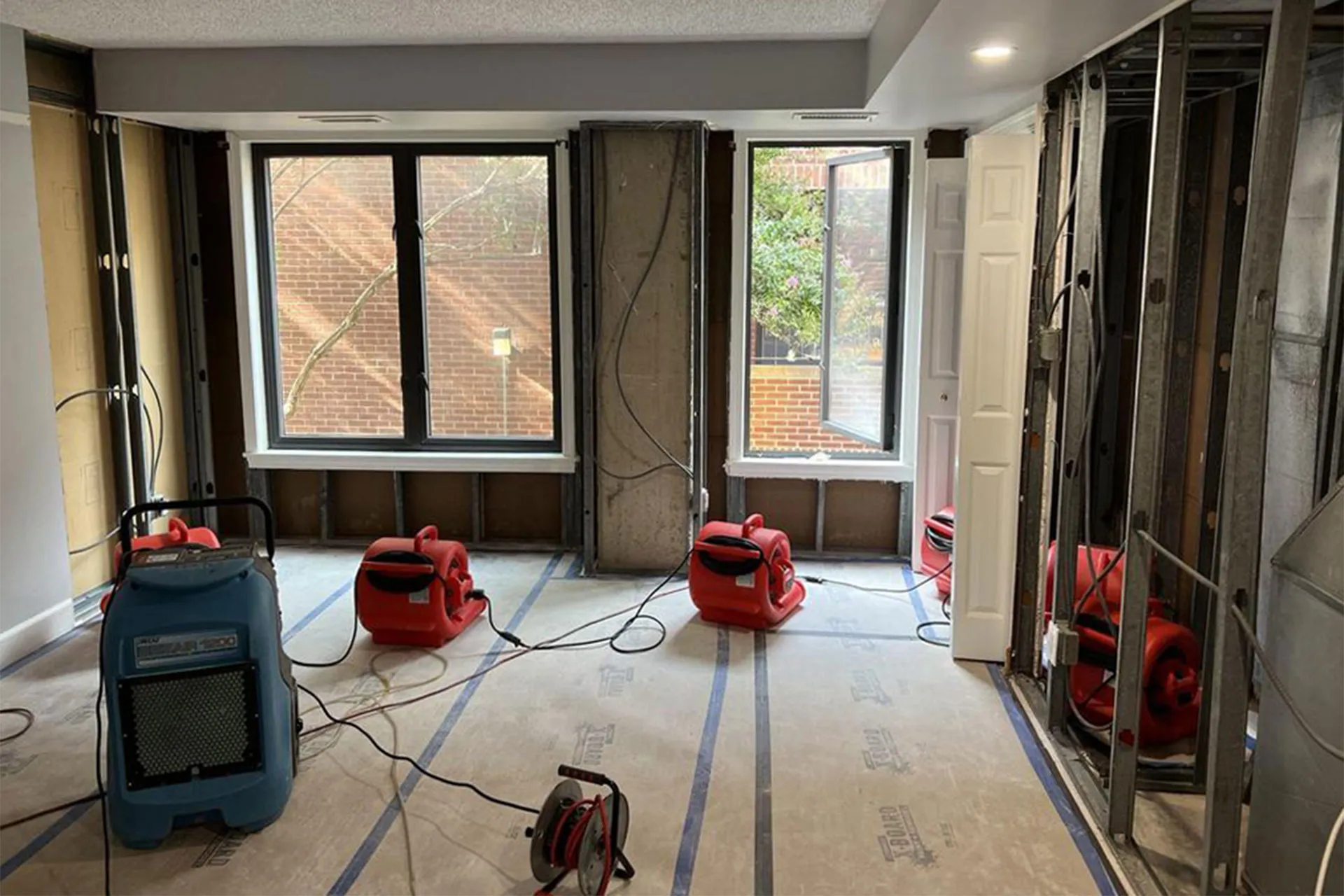
From the outside your business is one company. One building, one sign, one phone number. The trucks come out of the same lot, the crew list is a single sheet of paper, and the same person answers the phone whether the caller has water in a basement or a reading they want checked. You do restoration and you do radon mitigation, and you have never thought of yourself as two businesses.
Then the submission comes back as two programs, and it feels like paperwork getting in the way of something obvious.
It is not paperwork. This post is about why the split is real, where it comes from, and what part of it you should stop trying to fix — because the two trades you run sit on opposite sides of a single axis, and almost everything that looks like an administrative annoyance falls out of that one fact. The contractors pollution liability and professional liability pages own their own architecture and each explains its own line properly. What follows is the shape of the split, not the contents of either side.
What one roof actually shares
Start with the good news, because it is substantial and it is the reason the merged view feels right in the first place.
An enormous amount of this business genuinely is one business. The building is one building. The fleet is one fleet, and it underwrites as one fleet — the truck does not care which trade it drove to. The payroll is one payroll, and the crew that installs a system on Tuesday may be pulling material out of a basement on Thursday. The equipment lives in the same lot regardless of which trade bought it. The general liability spine sits underneath both trades and answers the same thing on both: the harm your operation does to other people and their property in the course of the work. A drill that finds a pipe is a drill that found a pipe, whichever job you were on.
So when an operator says “we are one company,” they are not being naive. They are describing something true about most of the program. The trouble is that “most” is doing quiet work in that sentence, and the part it excludes is the part that carries the weight.
The two trades keep time in opposite directions
Here is the whole thing, and it is simpler than the paperwork makes it look.
Restoration is called after the loss. Something already happened — the water came in, the fire burned, the sewage backed up, the growth took hold. You arrive at a structure that has already been hurt, and your job is to remove or dry or clean what the loss left behind. The event is in the past tense before your truck is in the driveway.
Radon mitigation exists before the hazard. Nothing has happened, and the entire point of your presence is that nothing should. You measure, you form a view about a risk that has produced no loss at all, and you install a system against a future that has not occurred. Success in your trade is a thing that never happens to anybody.
That is the axis, and every difference between the two programs falls out of it: one trade is paid to answer a loss that already exists, and the other is paid so that a loss never arrives. Once you can see the two hats that way, the split stops being bureaucratic and starts being the plainest description of your own business you will read this year.
Real-World Scenario: An operator runs both trades out of one shop. On a Monday a crew is dispatched to a Category 3 loss in a finished basement — the substance is already in the building, the scope is what to remove and how to dry what remains. On the Wednesday the same crew, in the same truck, sets a device in a house across town where nothing has gone wrong at all, and the report that goes out afterward carries the business’s name on a reading somebody is going to act on. Both jobs came off the same board, were driven in the same vehicle, and were performed by people on the same payroll. If a claim arrives from the Monday job, it will be about the substance the crew handled. If a claim arrives from the Wednesday job, it will be about the judgment the business signed. The truck, the crew, and the roof are common to both. Nothing else about those two claims resembles each other, and no single line answers them both.
One crew list, two underwriting conversations
Watch what happens when somebody actually underwrites you, because the divergence shows up faster than most operators expect.
On the restoration side the questions run toward substance and volume: what categories of loss you take, what leaves the site on your truck, how the work gets documented, how much of your work is insurer-funded, and how finished jobs are handled once the crew has gone. It is a conversation about material and about scale.
On the radon side the questions run somewhere else entirely: whether you measure, whether you mitigate, whether you do both at the same address, whose name goes on the report, and how the clearance step is handled after a system goes in. It is a conversation about judgment and about signatures.
Those are not two versions of one interview. They are two interviews that happen to concern the same payroll — and a submission that describes the business in a single sentence forces an underwriter to guess which trade the sentence was about. The guess is rarely generous.
Two signature lines, and neither covers for the other
Each trade has one line that carries its defining exposure, and this is where the merged view breaks for good.
The restoration side’s signature is contractors pollution liability. The short version — and it is only the short version, because that page tells it properly — is that the substance you were hired to remove is the very thing your general liability carves out through the pollution exclusion. The trade’s whole reason for existing sits in a gap in the policy everyone asks you to carry.
The radon side’s signature is professional liability. Again the short version: the measurement your business produces is an opinion, somebody makes a decision in reliance on it, and a challenge to that opinion is not a claim about anything your crew built. There is no standard ISO errors-and-omissions form written for this class — it is a manuscript market, which means the wording is the coverage. That page owns that story too.
Now put them side by side and notice the thing that matters. A policy written around a contaminant cannot answer a claim about a judgment; there is no contaminant in it. A policy written around professional opinion cannot answer a claim about a substance; nobody’s judgment is the loss. One trade’s signature line does not cover the other’s exposure, not because of a technicality or a market failure, but because they are aimed at different targets. Buying a strong answer to one question leaves the other question unasked.
Why the split will not tidy up
Operators reach for administrative fixes here, and it is worth saying plainly that there is not one available.
You cannot consolidate your way out of this. A single form that answered both a contamination loss and a professional judgment would have to be two forms wearing one cover — and the reason no insurer offers you that is not laziness. The two exposures behave differently: they arrive through different doors, they are triggered differently, and they are underwritten by people asking different questions. The market has not failed to merge them. It has correctly declined to pretend they are the same risk.
What you can do — and what usually happens on a well-built dual program — is arrange both lines inside one program with one insurer, so the administration is clean and the renewal is one conversation. That is a good outcome and worth asking for. Just be honest about what it is: two answers kept tidily in one folder, rather than one answer stretched across two trades. The tidiness is real. The merge is not.
<rect x="110" y="48" width="480" height="110" rx="10" fill="#F1E5D6" stroke="#12703F"/>
<text x="350" y="78" text-anchor="middle" font-family="Inter, system-ui, -apple-system, 'Segoe UI', Roboto, sans-serif" font-size="14" font-weight="600" fill="#12703F">One roof, one crew list, one set of trucks</text>
<text x="350" y="104" text-anchor="middle" font-family="Inter, system-ui, -apple-system, 'Segoe UI', Roboto, sans-serif" font-size="12" fill="#5A5048">The building, the fleet, the payroll, the general liability spine —</text>
<text x="350" y="124" text-anchor="middle" font-family="Inter, system-ui, -apple-system, 'Segoe UI', Roboto, sans-serif" font-size="12" fill="#5A5048">these really are one business, and they underwrite as one.</text>
<text x="350" y="148" text-anchor="middle" font-family="Inter, system-ui, -apple-system, 'Segoe UI', Roboto, sans-serif" font-size="13" font-weight="600" fill="#12703F">Where the business converges.</text>

<path d="M 280 160 L 190 202" fill="none" stroke="#12703F" stroke-width="2" marker-end="url(#axis-arrow)"/>
<path d="M 420 160 L 510 202" fill="none" stroke="#12703F" stroke-width="2" marker-end="url(#axis-arrow)"/>

<rect x="20" y="208" width="316" height="164" rx="9" fill="#ffffff" stroke="#12703F"/>
<text x="178" y="240" text-anchor="middle" font-family="Inter, system-ui, -apple-system, 'Segoe UI', Roboto, sans-serif" font-size="14" font-weight="600" fill="#12703F">Restoration — after the loss</text>
<text x="178" y="270" text-anchor="middle" font-family="Inter, system-ui, -apple-system, 'Segoe UI', Roboto, sans-serif" font-size="12" fill="#5A5048">Something already happened.</text>
<text x="178" y="290" text-anchor="middle" font-family="Inter, system-ui, -apple-system, 'Segoe UI', Roboto, sans-serif" font-size="12" fill="#5A5048">You are called to a structure that</text>
<text x="178" y="310" text-anchor="middle" font-family="Inter, system-ui, -apple-system, 'Segoe UI', Roboto, sans-serif" font-size="12" fill="#5A5048">has been hurt, and you remove</text>
<text x="178" y="330" text-anchor="middle" font-family="Inter, system-ui, -apple-system, 'Segoe UI', Roboto, sans-serif" font-size="12" fill="#5A5048">what the loss left behind.</text>
<text x="178" y="358" text-anchor="middle" font-family="Inter, system-ui, -apple-system, 'Segoe UI', Roboto, sans-serif" font-size="13" font-weight="600" fill="#12703F">Signature line: pollution.</text>

<rect x="364" y="208" width="316" height="164" rx="9" fill="#ffffff" stroke="#12703F"/>
<text x="522" y="240" text-anchor="middle" font-family="Inter, system-ui, -apple-system, 'Segoe UI', Roboto, sans-serif" font-size="14" font-weight="600" fill="#12703F">Radon — before the hazard</text>
<text x="522" y="270" text-anchor="middle" font-family="Inter, system-ui, -apple-system, 'Segoe UI', Roboto, sans-serif" font-size="12" fill="#5A5048">Nothing has happened, and the</text>
<text x="522" y="290" text-anchor="middle" font-family="Inter, system-ui, -apple-system, 'Segoe UI', Roboto, sans-serif" font-size="12" fill="#5A5048">whole point is that nothing should.</text>
<text x="522" y="310" text-anchor="middle" font-family="Inter, system-ui, -apple-system, 'Segoe UI', Roboto, sans-serif" font-size="12" fill="#5A5048">You measure, and you install</text>
<text x="522" y="330" text-anchor="middle" font-family="Inter, system-ui, -apple-system, 'Segoe UI', Roboto, sans-serif" font-size="12" fill="#5A5048">against a loss that has not come.</text>
<text x="522" y="358" text-anchor="middle" font-family="Inter, system-ui, -apple-system, 'Segoe UI', Roboto, sans-serif" font-size="13" font-weight="600" fill="#12703F">Signature line: professional.</text>

<text x="350" y="390" text-anchor="middle" font-family="Inter, system-ui, -apple-system, 'Segoe UI', Roboto, sans-serif" font-size="12" font-style="italic" fill="#5A5048">One trade’s signature line does nothing for the other.</text>

<rect x="30" y="402" width="640" height="88" rx="10" fill="#C7683F" stroke="#12703F"/>
<text x="350" y="432" text-anchor="middle" font-family="Inter, system-ui, -apple-system, 'Segoe UI', Roboto, sans-serif" font-size="15" font-weight="600" fill="#1A1A1A">One business. Two programs.</text>
<text x="350" y="456" text-anchor="middle" font-family="Inter, system-ui, -apple-system, 'Segoe UI', Roboto, sans-serif" font-size="13" fill="#1A1A1A">The split is not administrative — it is the axis the trades sit on.</text>
<text x="350" y="476" text-anchor="middle" font-family="Inter, system-ui, -apple-system, 'Segoe UI', Roboto, sans-serif" font-size="13" fill="#1A1A1A">Read each program against the trade it actually answers.</text>
The seam is which hat was on
Which leaves the part a dual operator actually has to manage day to day, and it is narrower than the whole program.
Most jobs are unambiguous. A basement full of water is the restoration hat. A house where nothing has gone wrong is the radon hat. The seam shows up where a single address gets both — a measurement, then an installation, then a clearance step — and the exposure crosses the axis more than once inside one invoice. The measurement was a judgment. The installation was physical work. The clearance was a judgment again. Same crew, same truck, same afternoon, three different shapes of exposure.
None of that is a problem to be solved. It is simply the reason a dual operator cannot reason about a job as one undifferentiated thing. If something is challenged long afterward, the question will be which act the challenge is aimed at — and the answer will be sitting in your own documentation, or it will not be sitting anywhere. Knowing which hat was on for each part of the work is not paperwork discipline for its own sake. It is what makes the two programs usable.
Questions for a business that runs both trades
None of this requires you to become an insurance professional. It requires somebody to look at your business as what it is — two trades sharing a spine — and ask a short list of structural questions on an ordinary day.
- Does my program carry a signature line for each trade, or one strong line and an assumption about the other?
- If a claim arrived tomorrow about a report my business signed, which policy answers — and do I own it?
- If a claim arrived tomorrow about a substance my crew removed, is that a different policy, and do I own that one too?
- Do the shared parts — the fleet, the crew, the equipment, the spine — actually reflect both trades, or only the busier one?
- When I describe my business on a submission, does the description contain both trades, or does it name one and imply the other?
Quick, specific answers mean somebody built the program around what you actually do. Vague answers are the finding, and you have collected them on a slow afternoon rather than during a claim.
Before your program treats you as one thing
The instinct to see your business as one company is correct about the building, the trucks, the crew, and the spine underneath both trades. It is wrong about the only two lines that carry the real weight, and it is wrong for a reason worth respecting rather than resenting: you run one operation that answers losses which have already happened, and another that exists so a loss never happens at all. No form merges those, because nothing merges those.
That is not a defect in your program. It is a description of your business that your program should match.
We build restoration contractor and radon mitigation contractor programs on the axis the two trades actually sit on — one spine, two edges, both read. If you run both hats out of one shop and want your program read that way, ask us for a quote.