

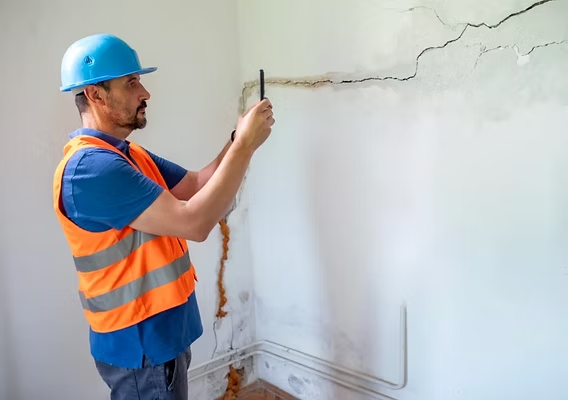
Take an inventory of a Minnesota restoration company on any given January day and you will find that most of what it owns is not on the premises. There are dehumidifiers running in a St. Cloud basement, air movers in a Rochester duplex, an air scrubber behind containment in a Minneapolis condo, and a generator sitting on a Duluth job four hours up the road. The shop holds a few spares and a lot of empty rack.
That is unusual, and it is the reason a policy written for a contractor whose tools sleep in a locked yard fits this trade badly. Nobody can quote this business off a table, because the number is assembled from what the operation actually looks like — and a Minnesota operation looks like a fleet in permanent deployment.
The asset that never sleeps at your shop
Contractors equipment is the line that answers for a fleet living away from home. Your gear is exposed three ways at once: in transit on a highway in the weather that generated the call; deployed on premises where you control neither access nor the people walking past it; and unattended for the days or weeks a structural dry-out takes.
The schedule should describe what you own and where it travels — not where it is garaged, because it is not garaged. An operator who owns a deployable fleet for freeze weeks carries a substantial schedule. An operator who subcontracts the drying carries almost none. Those are different companies and the schedule should say so.
What a wide, cold state does to a fleet
Minnesota stretches the problem. A single yard can serve the Twin Cities, St. Cloud, Rochester, and Duluth, which means equipment spending long hours in transit, crews driving in the conditions that caused the loss, and machines deployed on sites nobody from the office has seen in a week.
There is a second-order effect that matters more than the gear. A wide radius in a deep freeze lengthens the interval between the loss and the crew — and that interval is where the job changes character. A structure that sits wet grows mold, and a mitigation job becomes a remediation job. Distance, in other words, is not only an equipment question. Flood remains a separate NFIP placement.
Underneath the schedule: the exclusion that prices you
Here is the part that reorders the whole conversation. Your equipment is the asset you insure the most of. It is not what you are priced on.
A general liability policy answers for the third party injured on your site and the property you damage by accident, and it carries a pollution exclusion. Mold, the sewage in a Category 3 water loss, and the smoke and soot residue after a fire all read as pollutants under that exclusion — so the substance you are paid to remove is the substance the base policy will not answer for. Release spores opening a wall, miss a hidden reservoir, or certify a clearance that later fails, and the claim is environmental, and it is contractors pollution liability that responds, if anything does.
A stolen dehumidifier costs what a dehumidifier costs. A mold claim has no comparable ceiling. That asymmetry is why the underwriting question is not how much gear you own but how much of your revenue touches mold, Category 3, and fire work, and how disciplined the protocol around it is.
Rented gear, and the large-loss week
One practical point that only surfaces under pressure. When a freeze week or a single large loss outruns your fleet, you rent — and rented equipment does not always sit where owned equipment sits on the form. Some forms extend to gear you rent or borrow, some cap it at a sublimit, some say nothing at all.
That difference is invisible until the night you have three crews running borrowed machines across the metro. Worth reading the form in October rather than in January.
The crew in the crawlspace, and a license that is not there
Workers compensation runs through Minnesota’s private, competitive market and scales with payroll, with the classifications carrying as much weight as the figure. A technician in a respirator in a contaminated crawlspace is not in the same injury class as the person writing the estimate, and the classification should describe the work performed.
Next to the payroll sits this: research could verify no statewide mold-assessment or mold-remediation license in Minnesota. Mold work is contract-governed. Read that the right way round — an absent license does not mean a lighter file. Where a state writes a license, it publishes a standard of care a claim can be tested against. Minnesota publishes none, so your scope, your containment and clearance protocol, and your certifications become the standard, and they are read closely for exactly that reason. It is a compliance reality, not a fee, and it is not something we quote.
Contents, limits, and the record
If you pack out, the household goods you hold sit in your care, custody, and control — the thing general liability excludes — and bailees coverage is what answers. If you never touch contents, it does not belong on the program.
Your vehicles run on commercial auto, and a note on vocabulary this trade needs constantly: an insurance carrier writes your coverage, while a motor carrier hauls freight for hire. We mean the former.
Limits and retention are the free choice — fund routine damage yourself and buy a serious pollution and excess limit for the environmental tail. Your loss record then carries the argument, and with no state credential setting a floor, it carries more of it than it would elsewhere.
Most of this work is insurer-funded: the property owner’s carrier sets the scope you are paid on, and your receivables and program relationships follow from that. That is the environment you operate in, and we describe it as such — we do not advise property owners on their own claims, and this guide does not either.
Where your gear actually spends its life
<rect x="30" y="90" width="120" height="66" rx="9" fill="#F1E5D6" stroke="#12703F"/>
<text x="90" y="118" text-anchor="middle" font-family="Inter, system-ui, -apple-system, 'Segoe UI', Roboto, sans-serif" font-size="12.5" font-weight="600" fill="#12703F">The shop</text>
<text x="90" y="137" text-anchor="middle" font-family="Inter, system-ui, -apple-system, 'Segoe UI', Roboto, sans-serif" font-size="10.5" fill="#5A5048">Spares and empty rack</text>

<path d="M154 106 L214 74" fill="none" stroke="#12703F" stroke-width="2"/>
<path d="M154 123 L214 123" fill="none" stroke="#12703F" stroke-width="2"/>
<path d="M154 140 L214 172" fill="none" stroke="#12703F" stroke-width="2"/>

<rect x="218" y="52" width="446" height="46" rx="9" fill="#ffffff" stroke="#DCC9B0"/>
<text x="441" y="72" text-anchor="middle" font-family="Inter, system-ui, -apple-system, 'Segoe UI', Roboto, sans-serif" font-size="12.5" font-weight="600" fill="#12703F">In transit</text>
<text x="441" y="90" text-anchor="middle" font-family="Inter, system-ui, -apple-system, 'Segoe UI', Roboto, sans-serif" font-size="10.5" fill="#5A5048">On the highway, in the weather that made the call</text>

<rect x="218" y="104" width="446" height="46" rx="9" fill="#ffffff" stroke="#DCC9B0"/>
<text x="441" y="124" text-anchor="middle" font-family="Inter, system-ui, -apple-system, 'Segoe UI', Roboto, sans-serif" font-size="12.5" font-weight="600" fill="#12703F">Deployed where you control nothing</text>
<text x="441" y="142" text-anchor="middle" font-family="Inter, system-ui, -apple-system, 'Segoe UI', Roboto, sans-serif" font-size="10.5" fill="#5A5048">Somebody else’s premises, somebody else’s door</text>

<rect x="218" y="156" width="446" height="46" rx="9" fill="#ffffff" stroke="#DCC9B0"/>
<text x="441" y="176" text-anchor="middle" font-family="Inter, system-ui, -apple-system, 'Segoe UI', Roboto, sans-serif" font-size="12.5" font-weight="600" fill="#12703F">Unattended for the length of a dry-out</text>
<text x="441" y="194" text-anchor="middle" font-family="Inter, system-ui, -apple-system, 'Segoe UI', Roboto, sans-serif" font-size="10.5" fill="#5A5048">Days or weeks, hours from the yard</text>

<rect x="30" y="216" width="634" height="60" rx="9" fill="#C7683F" stroke="#12703F"/>
<text x="347" y="242" text-anchor="middle" font-family="Inter, system-ui, -apple-system, 'Segoe UI', Roboto, sans-serif" font-size="14" font-weight="600" fill="#1A1A1A">The fleet is what you insure the most of — the mold work is what you are priced on</text>
<text x="347" y="263" text-anchor="middle" font-family="Inter, system-ui, -apple-system, 'Segoe UI', Roboto, sans-serif" font-size="12" font-weight="600" fill="#1A1A1A">A stolen machine has a ceiling. An environmental claim does not.</text>Plainly
Your fleet is the visible part of a Minnesota restoration business and it deserves a schedule that matches reality: owned and rented, across a radius that reaches the edges of the state. Get that right and you stop being underinsured on the asset you use every day.
Then look past it. The number is decided by how much mold, sewage, and fire work you take on and whether the pollution line that answers for it is on your program — in a state that has written no credential to stand in its place.
For the coverage rather than the pricing, start with contractors pollution liability; the restoration contractor insurance program shows how it assembles, and the Minnesota restoration contractor insurance page carries the state detail. For a figure built on your own operation, start a quote. If you test and mitigate radon rather than respond to losses, you want the radon mitigation cost guide instead.