

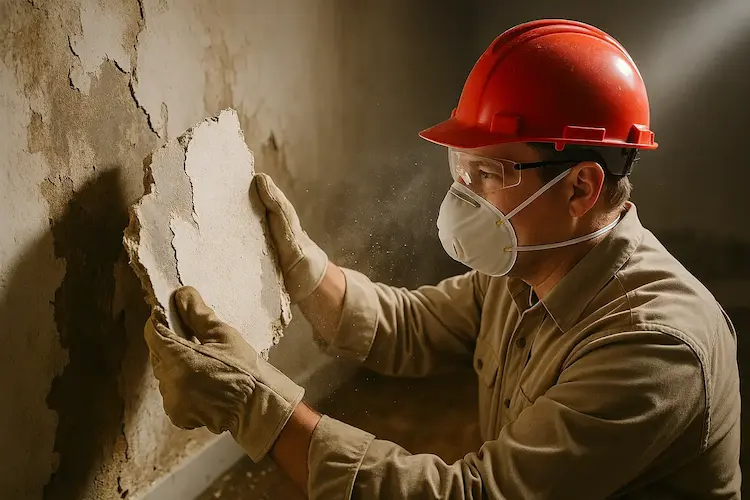
There is no published price for restoration contractor insurance in Pennsylvania, and any number you see quoted before an underwriter has looked at your work is a guess. What a carrier actually does is build the cost from your specific operation — and for a restoration contractor, the input that moves the number most is not the building you work out of or the trucks you drive. It is how much of your work carries an exposure the standard policy quietly refuses to cover.
That is the counterintuitive part, so it is worth saying first. The very substances a Pennsylvania restoration crew is hired to remove — mold, the sewage in a Category 3 water loss, the smoke and soot after a fire — are treated as pollutants under the standard general-liability pollution exclusion. The loss you are most likely to cause while doing your job well is the one your base policy carves out. This guide walks the drivers that decide what a Pennsylvania restoration contractor actually pays.
The pollution line comes first
This is the driver that sizes the program, and it is the one a generic contractor policy gets wrong. A standard general liability policy answers for the third party hurt on your jobsite and the property you damage by accident — but it carries a pollution exclusion, and an underwriter of restoration risk reads that exclusion against the work you actually do.
Mold is the clearest case: spread spores during a demolition, miss a hidden reservoir behind a wall, or certify a clearance that later fails, and the claim that follows is an environmental claim, answered — if at all — by contractors pollution liability. Category 3 sewage reads the same way, and so does the smoke and soot a fire leaves behind. The underwriting question is never “how big is your crew.” It is: how much of your revenue touches mold, sewage, and fire remediation, and how disciplined is the protocol around it?
Winter freeze and the burst-pipe wave
Pennsylvania’s signature restoration driver is water, and much of it is cold. Winter freeze, ice, and snow drive burst-pipe losses across Philadelphia, Pittsburgh, the Lehigh Valley, and Erie; remnant-tropical rainfall and river flooding on the Susquehanna and Delaware basins fill in the wet-season work as a separate NFIP placement.
That matters to your premium because freeze-season water work is mitigation work — the emergency, after-the-loss phase where the pollution and equipment exposures concentrate. Extraction, structural drying, containment, and the deployable fleet that does it all live here, and a contaminated loss brings the Category 3 sewage exposure forward with them. An operator whose book leans on freeze-season mitigation carries a different risk than one weighted toward the reconstruction that follows.
The Home Improvement registration is not a mold license
Owners sometimes assume the state registration they already hold covers the mold side of the work. It does not, and the distinction is one an underwriter reads closely.
Pennsylvania requires a Home Improvement Contractor registration for home-improvement work above a threshold — but that registration is not a mold-specific credential, and the state licenses no mold assessment or remediation of its own. So even a registered contractor performing mold work operates without a state standard of care specific to that work. The perimeter around a mold claim is the contract, the protocol, and any national certification you carry — which is exactly why the agreement you sign and the pollution line you buy are doing part of the job a mold license does in a licensing state.
Trade mix: mitigation, rebuild, and pack-out
What you do shapes what you pay, because the three phases of restoration are three risk profiles under one company name.
- Mitigation — extraction, drying, containment — is where the pollution and equipment exposures concentrate.
- Reconstruction carries a construction risk instead: the completed-operations tail on a rebuild that can follow you for years, plus the ordinary trade exposures of putting a structure back together.
- Contents pack-out puts other people’s property in your care, which is its own line entirely.
A pure mitigation shop, a full mitigation-to-rebuild general contractor, and a contents-heavy operator are three different submissions, and an underwriter wants the split.
Payroll and a competitive comp market
Workers compensation scales with payroll, and the classifications you run matter as much as the figure — a crew in respirators in a contaminated crawlspace is not a clerical class. Pennsylvania runs a competitive market in which a state fund competes alongside private carriers without being monopolistic, so the discipline is honest classification of your mitigation, reconstruction, and remediation crews and a low injury profile through respirator, confined-space, and fall-protection practice.
Equipment, contents, and the claims economy
The equipment schedule. Contractors equipment covers the dehumidifiers, air movers, air scrubbers, and generators that live on a customer’s loss site for the length of a dry-out — in transit, deployed where you do not control the premises, and exposed to theft. Where those travel behind your own service trucks, commercial auto sizes to the vehicles; here carrier means the insurance company writing your coverage, not a motor carrier hauling freight.
The contents line. Pack out a customer’s furniture, electronics, and documents and hold them at your facility, and those goods are in your care, custody, and control — exactly what the general-liability policy carves out. Bailees coverage answers for them.
The claims economy. Most restoration work arrives insurer-funded — the property owner’s carrier sets the scope you are paid on, and your receivables and program relationships flow from that reality. We describe that economy because it shapes your exposure; we do not advise a property owner on their own claim, and this guide does not either.
Limits, retention, and claims history
Claims history moves pricing more than almost anything else on this list — not just whether you have had losses, but what they say about how the operation runs. Limits and retention are a genuine choice: how much of the small stuff you fund yourself in exchange for a better price on the pollution and excess limit you cannot afford to be short on when a large mold or fire loss lands.
What an underwriter is actually stacking
<rect x="40" y="46" width="620" height="60" rx="9" fill="#C7683F" stroke="#12703F"/>
<text x="350" y="72" text-anchor="middle" font-family="Inter, system-ui, -apple-system, 'Segoe UI', Roboto, sans-serif" font-size="15" font-weight="600" fill="#1A1A1A">How deep the pollution exposure runs: mold, sewage, smoke, and soot</text>
<text x="350" y="94" text-anchor="middle" font-family="Inter, system-ui, -apple-system, 'Segoe UI', Roboto, sans-serif" font-size="12.5" font-weight="600" fill="#1A1A1A">It sizes the contractors pollution liability limit</text>

<rect x="40" y="118" width="620" height="44" rx="9" fill="#ffffff" stroke="#DCC9B0"/>
<text x="350" y="137" text-anchor="middle" font-family="Inter, system-ui, -apple-system, 'Segoe UI', Roboto, sans-serif" font-size="14" font-weight="600" fill="#12703F">Winter freeze and the burst-pipe mitigation wave</text>
<text x="350" y="154" text-anchor="middle" font-family="Inter, system-ui, -apple-system, 'Segoe UI', Roboto, sans-serif" font-size="11.5" fill="#5A5048">Emergency water work — where the pollution and equipment risk concentrates</text>

<rect x="40" y="172" width="620" height="44" rx="9" fill="#ffffff" stroke="#DCC9B0"/>
<text x="350" y="191" text-anchor="middle" font-family="Inter, system-ui, -apple-system, 'Segoe UI', Roboto, sans-serif" font-size="14" font-weight="600" fill="#12703F">The contract, because the registration is not a mold license</text>
<text x="350" y="208" text-anchor="middle" font-family="Inter, system-ui, -apple-system, 'Segoe UI', Roboto, sans-serif" font-size="11.5" fill="#5A5048">Home Improvement registration governs the rebuild, not the mold work</text>

<rect x="40" y="226" width="620" height="44" rx="9" fill="#ffffff" stroke="#DCC9B0"/>
<text x="350" y="245" text-anchor="middle" font-family="Inter, system-ui, -apple-system, 'Segoe UI', Roboto, sans-serif" font-size="14" font-weight="600" fill="#12703F">The drying fleet, and the contents you hold in a pack-out</text>
<text x="350" y="262" text-anchor="middle" font-family="Inter, system-ui, -apple-system, 'Segoe UI', Roboto, sans-serif" font-size="11.5" fill="#5A5048">Gear deployed where you do not control the site; goods in your care</text>

<rect x="40" y="280" width="620" height="44" rx="9" fill="#ffffff" stroke="#DCC9B0"/>
<text x="350" y="299" text-anchor="middle" font-family="Inter, system-ui, -apple-system, 'Segoe UI', Roboto, sans-serif" font-size="14" font-weight="600" fill="#12703F">The program and TPA claims economy you operate inside</text>
<text x="350" y="316" text-anchor="middle" font-family="Inter, system-ui, -apple-system, 'Segoe UI', Roboto, sans-serif" font-size="11.5" fill="#5A5048">Insurer-funded volume and counterparties — described, never advised</text>

<rect x="40" y="334" width="620" height="44" rx="9" fill="#ffffff" stroke="#DCC9B0"/>
<text x="350" y="353" text-anchor="middle" font-family="Inter, system-ui, -apple-system, 'Segoe UI', Roboto, sans-serif" font-size="14" font-weight="600" fill="#12703F">Claims history, and the limits and retention you choose</text>
<text x="350" y="370" text-anchor="middle" font-family="Inter, system-ui, -apple-system, 'Segoe UI', Roboto, sans-serif" font-size="11.5" fill="#5A5048">What your losses say about how the operation actually runs</text>

<text x="350" y="392" text-anchor="middle" font-family="Inter, system-ui, -apple-system, 'Segoe UI', Roboto, sans-serif" font-size="11.5" font-style="italic" fill="#5A5048">None of these is a price. Together they are how one gets built.</text>
The honest summary
A Pennsylvania restoration contractor is priced on exposure, not on square footage. The freeze matters, the flooding matters, the reconstruction matters — but the thing that moves the number most is how much of your work touches the mold, sewage, and fire the standard policy refuses to cover, and whether your program carries the pollution line that answers for it while your registration handles only the rebuild.
If you want to see how the coverage itself works rather than what it costs, start with contractors pollution liability — the line this whole conversation is really about — or step back to the restoration contractor insurance program and the full Pennsylvania restoration contractor insurance page. When you are ready for a number built on your real operation, start a quote. And if you test and mitigate radon rather than respond to losses, none of the above is your program: you want the radon mitigation cost guide instead.