

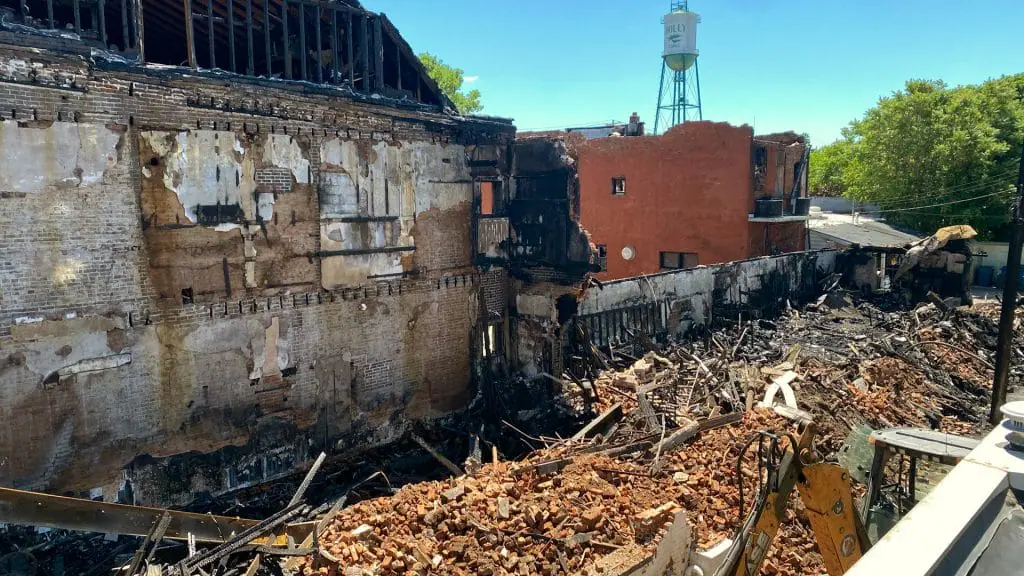
There is no published price for restoration contractor insurance in Washington, and any number you see quoted before an underwriter has looked at your work is a guess. What a carrier actually does is build the cost from your specific operation — and for a restoration contractor, the input that moves the number most is not the building you work out of or the trucks you drive. It is how much of your work carries an exposure the standard policy quietly refuses to cover.
That is the part owners find counterintuitive, so it is worth saying plainly before anything else. The very substances you are hired to remove — mold, the sewage in a Category 3 water loss, the smoke and soot after a fire — are treated as pollutants under the standard general-liability pollution exclusion. The loss you are most likely to cause while doing your job well is the one your base policy carves out. This guide walks the drivers that decide what a Washington restoration contractor actually pays, roughly in the order they matter — and it flags one line that leaves the commercial program entirely.
The pollution line, and how deep it runs in your work
This is the driver that sizes the program, and it is the one a generic contractor policy gets wrong. A standard general liability policy answers for the third party hurt on your jobsite and the property you damage by accident — but it carries a pollution exclusion, and an underwriter of restoration risk reads that exclusion against the work you actually do.
Mold is the clearest case, and in Washington’s marine climate it is a constant. West of the Cascades a structure rarely dries fully, so a water loss that sits — after an atmospheric-river event or a burst pipe — grows mold readily, and the remediation is where the exposure lives: spread spores during a demolition, miss a hidden reservoir behind a wall, or certify a clearance that later fails, and the claim is an environmental claim — carved out of the base policy and answered, if at all, by contractors pollution liability. Category 3 sewage work reads the same way, and so does the wildfire smoke-and-soot residue that reaches the interior. So the underwriting question is never “how big is your crew.” It is: how much of your revenue touches mold, sewage, and fire remediation, and how disciplined is the containment and clearance protocol around it? The pollution exposure — not the payroll — is the thing being sized.
The comp line that leaves your commercial program
Most of this guide describes lines a private carrier writes inside one program. Washington forces an exception worth putting up front, because it changes the shape of what you buy.
Washington is a monopolistic workers-compensation state. Coverage comes through the state fund at the Department of Labor and Industries — not from a private carrier — with qualified self-insurance the only alternative for operators who meet its bar. That means the workers compensation piece is not a line inside the commercial program we place; it sits alongside it, administered by the state. The general liability, the contractors pollution liability, the equipment, the contents, and the auto are the lines a private market writes and the ones this cost guide is really about.
It matters to keep the two clearly separate. A program quoted as though comp were bundled in would misstate what you are actually buying, and an owner comparing a Washington quote against one from a private-comp state is comparing two different structures. Your crew still faces the same confined-space and contaminated-environment injury exposure — respirators in a damp basement, a fall on a wet roof — and the safety record you build with Labor and Industries is its own track. We build the private-market program; the state fund handles comp.
Your trade mix: mitigation, rebuild, and pack-out
What you do shapes what you pay, because the three phases of restoration are three different risk profiles wearing one company name.
- Mitigation — the emergency, after-the-loss phase — is where the pollution and equipment exposures concentrate: water extraction, structural drying, containment, and the deployable fleet that does it.
- Reconstruction carries a construction risk instead: the completed-operations tail on a rebuild that can follow you for years, and the ordinary trade exposures of putting a structure back together.
- Contents pack-out puts other people’s property in your care, which is its own line entirely (below).
A pure mitigation shop, a full mitigation-to-rebuild general contractor, and a contents-heavy operator are three different submissions. An underwriter wants the split, because a program built for one of them is mispriced for the other two.
Two climates under one state, and the mold license Washington does not write
Washington hands a restoration contractor two exposure profiles divided by the Cascades. West of the mountains — Seattle, Tacoma, Vancouver, Everett — atmospheric-river flooding, winter storms, and a damp marine climate drive water losses and the mold that follows a structure that never fully dries. In the drier interior around Spokane, wildfire adds a smoke-and-soot exposure and the cold months bring freeze losses. An underwriter reads which side of the mountains your book sits on, because it shapes the mix the pollution line prices.
The licensing picture is worth stating precisely: Washington has no mold-specific credential. General and specialty contractors register with the Department of Labor and Industries, but there is no dedicated mold-remediation license, so mold work is contract-governed. Where a state license sets a standard of care an underwriter can lean on, Washington leaves the mold perimeter to your contract, your protocol, and the certification you hold — which tends to push weight onto the pollution and professional coverage. It is a fact an underwriter reads, not a fee anyone quotes.
The drying fleet, and the contents in your care
Two more lines that a generic policy sizes wrong because it assumes your equipment sleeps in your yard and your work never touches someone else’s property.
The equipment schedule. Contractors equipment covers the dehumidifiers, air movers, air scrubbers, and generators that live on a customer’s site for the length of a dry-out — in transit, deployed where you do not control the premises, and exposed to theft. A fleet that runs hard through atmospheric-river season on the wet side needs a schedule that reflects what you actually own and, where the form allows, what you rent during a large loss.
The contents line. The moment you pack out a customer’s furniture, electronics, textiles, and documents and hold them at your facility, those goods are in your care, custody, and control — exactly what the general-liability policy carves out. Bailees coverage answers for them. If pack-out and storage are in your mix, this line belongs in the program; if you never touch contents, it does not.
The claims economy you operate inside
Most restoration work arrives insurer-funded — the property owner’s carrier sets the scope you are paid on, and your receivables, your program relationships, and your third-party administrator work all flow from that reality. An underwriter reads it as a business-model fact, not a coverage question. We describe that economy because it shapes your exposure; we do not advise a property owner on their own claim, and this guide does not either. What matters for your premium is the volume and the counterparties: a book weighted toward program and TPA work underwrites differently from a book of direct retail losses.
Limits, retention, and claims history
Two levers, and one is entirely in your hands.
Claims history moves pricing more than almost anything else on the commercial program — not just whether you have had losses, but what they say about how the operation runs. A cluster of small water claims tells an underwriter something different from one large mold or pollution claim, and in a state with no mold license to set a floor, that record carries extra weight.
Limits and retention are a genuine choice: how much of the small stuff to fund yourself in exchange for a better price on the part you cannot afford. A contractor who can absorb routine handling damage and buys a serious pollution and excess limit for the environmental and large-loss tail is usually buying insurance in the right order.
Where the comp line goes in a monopolistic state
<rect x="30" y="52" width="380" height="256" rx="11" fill="#ffffff" stroke="#DCC9B0"/>
<text x="220" y="76" text-anchor="middle" font-family="Inter, system-ui, -apple-system, 'Segoe UI', Roboto, sans-serif" font-size="13" font-weight="600" fill="#5A5048">The commercial program a private carrier writes</text>

<rect x="52" y="90" width="336" height="52" rx="9" fill="#C7683F" stroke="#12703F"/>
<text x="220" y="112" text-anchor="middle" font-family="Inter, system-ui, -apple-system, 'Segoe UI', Roboto, sans-serif" font-size="13.5" font-weight="600" fill="#1A1A1A">Contractors pollution liability</text>
<text x="220" y="130" text-anchor="middle" font-family="Inter, system-ui, -apple-system, 'Segoe UI', Roboto, sans-serif" font-size="11.5" font-weight="600" fill="#1A1A1A">The line that anchors the whole program</text>

<rect x="52" y="150" width="162" height="42" rx="8" fill="#ffffff" stroke="#DCC9B0"/>
<text x="133" y="176" text-anchor="middle" font-family="Inter, system-ui, -apple-system, 'Segoe UI', Roboto, sans-serif" font-size="12" font-weight="600" fill="#12703F">General liability</text>
<rect x="226" y="150" width="162" height="42" rx="8" fill="#ffffff" stroke="#DCC9B0"/>
<text x="307" y="176" text-anchor="middle" font-family="Inter, system-ui, -apple-system, 'Segoe UI', Roboto, sans-serif" font-size="12" font-weight="600" fill="#12703F">Equipment</text>
<rect x="52" y="200" width="162" height="42" rx="8" fill="#ffffff" stroke="#DCC9B0"/>
<text x="133" y="226" text-anchor="middle" font-family="Inter, system-ui, -apple-system, 'Segoe UI', Roboto, sans-serif" font-size="12" font-weight="600" fill="#12703F">Contents / bailees</text>
<rect x="226" y="200" width="162" height="42" rx="8" fill="#ffffff" stroke="#DCC9B0"/>
<text x="307" y="226" text-anchor="middle" font-family="Inter, system-ui, -apple-system, 'Segoe UI', Roboto, sans-serif" font-size="12" font-weight="600" fill="#12703F">Commercial auto</text>

<text x="220" y="288" text-anchor="middle" font-family="Inter, system-ui, -apple-system, 'Segoe UI', Roboto, sans-serif" font-size="11.5" font-style="italic" fill="#5A5048">The lines this cost guide is really about</text>

<path d="M414 168 L470 168" fill="none" stroke="#12703F" stroke-width="2.5" marker-end="url(#waarrow)"/>
<defs>
  <marker id="waarrow" markerWidth="9" markerHeight="9" refX="7" refY="4.5" orient="auto">
    <path d="M0 0 L9 4.5 L0 9 z" fill="#12703F"/>
  </marker>
</defs>

<rect x="474" y="120" width="196" height="96" rx="11" fill="#F1E5D6" stroke="#12703F"/>
<text x="572" y="152" text-anchor="middle" font-family="Inter, system-ui, -apple-system, 'Segoe UI', Roboto, sans-serif" font-size="13" font-weight="600" fill="#12703F">Workers compensation</text>
<text x="572" y="174" text-anchor="middle" font-family="Inter, system-ui, -apple-system, 'Segoe UI', Roboto, sans-serif" font-size="11.5" fill="#5A5048">The state fund at</text>
<text x="572" y="190" text-anchor="middle" font-family="Inter, system-ui, -apple-system, 'Segoe UI', Roboto, sans-serif" font-size="11.5" fill="#5A5048">Labor and Industries</text>

<text x="350" y="326" text-anchor="middle" font-family="Inter, system-ui, -apple-system, 'Segoe UI', Roboto, sans-serif" font-size="12" font-style="italic" fill="#5A5048">None of these is a price. Together they are how one gets built.</text>The honest summary
A Washington restoration contractor is priced on exposure, not on square footage. The trucks matter, the crew matters, the atmospheric rivers matter — but the thing that moves the number most on your commercial program is how much of your work touches the mold, sewage, and fire the standard policy refuses to cover, and whether that program carries the pollution line which answers for it. Workers compensation sits separately, through the state fund, and with no state mold license to set a floor, the pollution coverage and your own protocol carry weight a credential carries elsewhere.
If you want to see how the coverage itself works rather than what it costs, start with contractors pollution liability — the line this whole conversation is really about — or step back to the restoration contractor insurance program and the full Washington restoration contractor insurance page. When you are ready for a number built on your real operation, start a quote. And if you test and mitigate radon rather than respond to losses, none of the above is your program: you want the radon mitigation cost guide instead.