

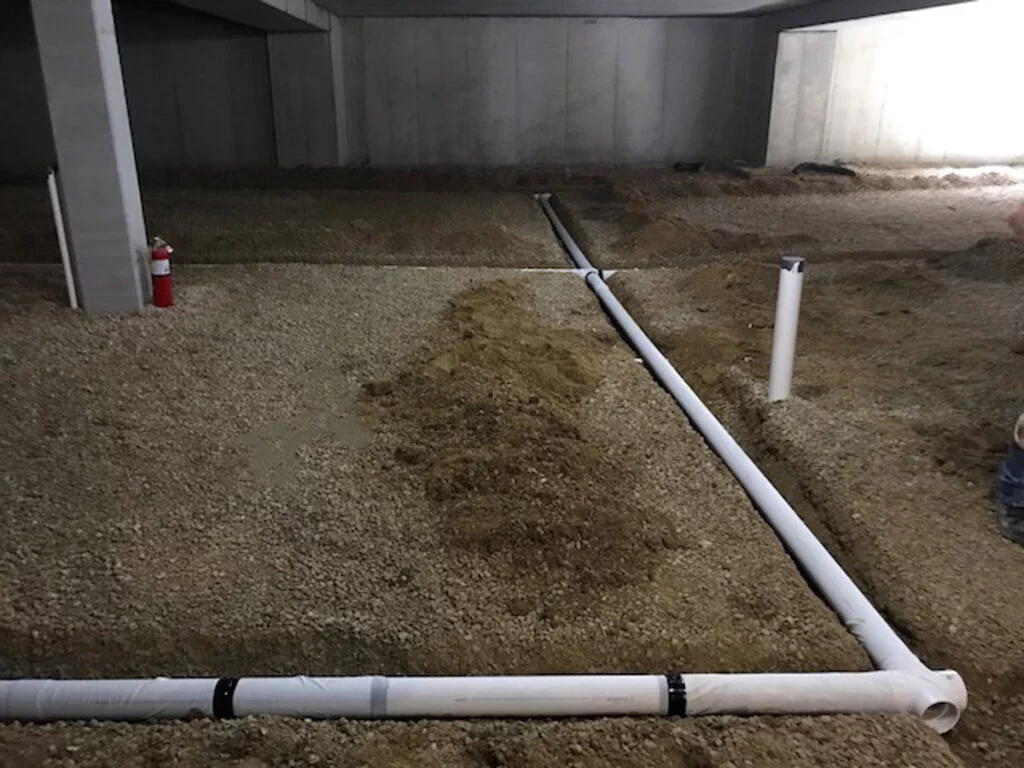
Michigan’s residential building code requires radon-resistant construction in nine south-central counties. Then it stops.
Stand on one of those boundaries and look at what the rule has produced. On this side, a new house arrives with a passive system built into it because the code said so. On the other side of the road, an identical house, built by the same crews, sitting on the same ground, arrives with nothing at all.
The soil did not consult the county line. It has never heard of it. But the rule stops there, and your market is sorted by it whether that makes any sense or not — which is one of several reasons nobody can hand you a price from a table.
A line the ground does not know about
County boundaries were drawn for administrative reasons that had nothing to do with what is underneath them. The EPA’s Zone 1 band runs through the south-central part of the state on geological grounds, and geology does not resolve neatly at a surveyed edge.
So the nine-county rule is a reasonable administrative approximation of a continuous physical fact — which is what most rules are, and which is fine right up until somebody mistakes the approximation for the fact.
That mistake is available to your customers constantly. A house outside the code counties can read high. A house inside them can read low. And a zone describes potential across an area rather than making any claim at all about an individual address, which is the entire reason somebody hires you instead of looking at a map.
What the boundary actually sorts
For your business the line matters, just not for the reason people assume. It does not sort houses by risk. It sorts expectations.
Inside the nine counties, new stock arrives with passive systems, builders know the subject exists, and buyers have frequently heard of radon before you say the word. The conversation starts somewhere.
Outside them, the conversation starts at zero. Nobody built anything, nobody mentioned it, and the topic arrives with you.
So crossing that line changes your sales effort, your work mix, and the assumptions you are working against — while changing nothing whatsoever about what is under the house. That mismatch is the practical shape of operating in this state.
The house that has a system and no answer
There is a second-order effect worth understanding, because it is where a good deal of Michigan work actually lives.
Radon-resistant construction under the code is a builder’s obligation, performed before anyone lives in the house. It produces a system. It does not produce a measurement.
So a code-compliant house is a house that complied. Whether the installed approach actually achieves what the occupant needs is a question of fact rather than of compliance, and the code did not ask it. Nobody was required to find out.
That gap is your work — and note what kind of work it is. Answering it means producing a number somebody will rely on. It is not a fitting exercise. It is a professional one.
The reading, and who acts on it
Which brings the program to its anchor.
A standard policy is built around general liability — the visitor who trips over your equipment, the property you damage by accident. Real; not definitive. What defines this trade is that you are paid to produce a number, and somebody makes a decision on it.
A device placed somewhere unrepresentative, a short-term test disturbed by conditions you did not control, a protocol chosen loosely, a post-mitigation clearance passing a house that should have failed — each is a claim about your judgment, and professional liability is what answers, not the general-liability line. How much of your revenue rides on opinions people act on, and how disciplined the protocol behind them is, is the heaviest input into where you price. The code boundary does not touch it in either direction.
A rule for the building and none for the practitioner
Michigan issues no state radon license. The environmental agency encourages nationally certified professionals through NRPP or NRSB.
Set that beside the code and the pairing is striking. The state was willing to write a construction requirement into its residential code for nine counties — a real rule, with real force, aimed at buildings. And it was unwilling to say anything at all about who is competent to measure or mitigate radon in those same houses.
The building got a rule. The practitioner did not. So your written scope, your protocol, your calibration discipline, and the certification you chose to hold are the entire standard, and an underwriter reads them as such. Certification carries its own fees; not insurance, and not something we quote.
Instruments, crew, and the record
The equipment is modest and specific: continuous monitors, grab-sample devices, manometers and pressure gauges, and system materials. Contractors equipment schedules it for what it is worth and where it travels — precise instruments rather than a heavy fleet. Vehicles ride on commercial auto, and one point of vocabulary this trade needs: an insurance carrier is the company writing your coverage, not a motor carrier hauling freight.
Where you install, the crew exposure is real: confined-space entry into crawlspaces and attics, coring through slab, pipe and fan run in tight spaces. Workers compensation runs through a private, competitive market here, and the classifications should describe that work rather than the trade name.
Your loss record carries weight beyond its length, because a professional claim speaks to the judgment the business rests on. Limits and retention are the genuine choice: fund the small things and buy a serious professional and excess limit.
What the code boundary sorts, and what it does not
<rect x="30" y="54" width="300" height="122" rx="9" fill="#F1E5D6" stroke="#12703F"/>
<text x="180" y="78" text-anchor="middle" font-family="Inter, system-ui, -apple-system, 'Segoe UI', Roboto, sans-serif" font-size="13" font-weight="600" fill="#12703F">Inside the nine counties</text>
<text x="180" y="100" text-anchor="middle" font-family="Inter, system-ui, -apple-system, 'Segoe UI', Roboto, sans-serif" font-size="11" fill="#5A5048">Code requires radon-resistant construction</text>
<text x="180" y="120" text-anchor="middle" font-family="Inter, system-ui, -apple-system, 'Segoe UI', Roboto, sans-serif" font-size="11" fill="#5A5048">New stock arrives with a passive system</text>
<text x="180" y="140" text-anchor="middle" font-family="Inter, system-ui, -apple-system, 'Segoe UI', Roboto, sans-serif" font-size="11" fill="#5A5048">Builders and buyers know the topic</text>
<text x="180" y="164" text-anchor="middle" font-family="Inter, system-ui, -apple-system, 'Segoe UI', Roboto, sans-serif" font-size="11" font-style="italic" fill="#5A5048">The conversation starts somewhere</text>

<path d="M350 50 L350 180" fill="none" stroke="#12703F" stroke-width="2.5" stroke-dasharray="6 4"/>
<text x="350" y="196" text-anchor="middle" font-family="Inter, system-ui, -apple-system, 'Segoe UI', Roboto, sans-serif" font-size="10.5" font-style="italic" fill="#12703F">a surveyed edge</text>

<rect x="370" y="54" width="300" height="122" rx="9" fill="#ffffff" stroke="#DCC9B0"/>
<text x="520" y="78" text-anchor="middle" font-family="Inter, system-ui, -apple-system, 'Segoe UI', Roboto, sans-serif" font-size="13" font-weight="600" fill="#12703F">Outside them</text>
<text x="520" y="100" text-anchor="middle" font-family="Inter, system-ui, -apple-system, 'Segoe UI', Roboto, sans-serif" font-size="11" fill="#5A5048">No requirement at all</text>
<text x="520" y="120" text-anchor="middle" font-family="Inter, system-ui, -apple-system, 'Segoe UI', Roboto, sans-serif" font-size="11" fill="#5A5048">Identical house, identical ground</text>
<text x="520" y="140" text-anchor="middle" font-family="Inter, system-ui, -apple-system, 'Segoe UI', Roboto, sans-serif" font-size="11" fill="#5A5048">Nobody has raised it</text>
<text x="520" y="164" text-anchor="middle" font-family="Inter, system-ui, -apple-system, 'Segoe UI', Roboto, sans-serif" font-size="11" font-style="italic" fill="#5A5048">The conversation starts at zero</text>

<rect x="30" y="206" width="640" height="58" rx="9" fill="#C7683F" stroke="#12703F"/>
<text x="350" y="230" text-anchor="middle" font-family="Inter, system-ui, -apple-system, 'Segoe UI', Roboto, sans-serif" font-size="13.5" font-weight="600" fill="#1A1A1A">The line sorts expectations. It does not sort risk.</text>
<text x="350" y="251" text-anchor="middle" font-family="Inter, system-ui, -apple-system, 'Segoe UI', Roboto, sans-serif" font-size="11.5" font-weight="600" fill="#1A1A1A">A zone describes an area — only your measurement describes the address</text>The Michigan point
The nine-county line is real and it shapes your working life: it decides whether the topic arrives with you or before you, and whether the new stock you walk into already has a system in it. Use it to understand your market.
Do not let anyone — including yourself — use it to understand a house. The ground does not stop at the road, a code-compliant system is a system rather than an answer, and the only thing that settles any individual address is a measurement you took and stand behind. The state wrote a rule for the building and none for you, which means the standard behind that measurement is entirely your own.
For the coverage rather than the pricing, start with professional liability; the radon mitigation insurance program shows how it assembles, and the Michigan radon mitigation insurance page carries the state detail. For a figure built on your real operation, start a quote. If you respond to water, fire, and mold losses rather than testing and mitigating radon, the restoration cost guide is your program instead.