

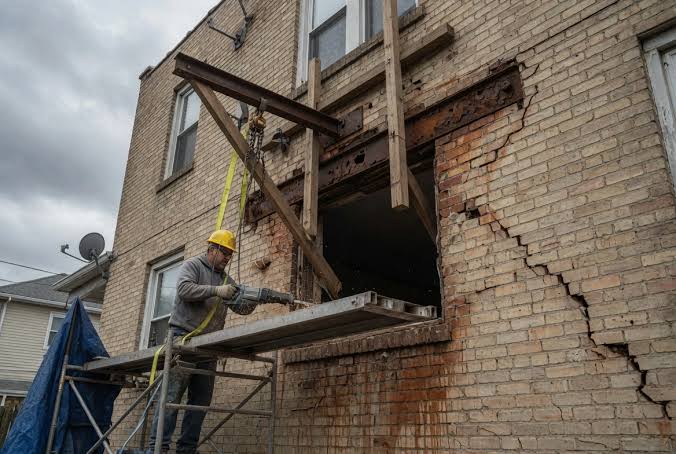
A Michigan restoration company is usually two businesses sharing a name, a logo, and a payroll. One of them shows up at two in the morning when a pipe lets go in a Warren duplex, extracts the water, sets the air movers, and leaves when the structure reads dry. The other one comes back three weeks later to put the walls, floors, and cabinets back.
Those two businesses do not end the same way. The drying work finishes when the equipment comes off the site. The rebuild never quite finishes — it stands there, and a defect in what you built can surface years later, long after the file closed and the invoice cleared. That difference is the first thing an underwriter separates out, and it is why no one can hand you a shelf price for this trade.
The work that follows you after the crew leaves
Completed operations is the liability that outlives the job. On the mitigation side it is thin: dry the structure correctly and the exposure largely closes with the file. On the reconstruction side it is the whole point — a rebuilt wall assembly, a re-roofed section, a re-set subfloor all remain in service, and a failure in any of them can produce a claim on a horizon measured in years rather than weeks.
This is why an underwriter asks for your reconstruction revenue rather than your total revenue. The tail prices off the rebuild. A program scoped to the drying work and sold to a company that also rebuilds is not a cheaper program; it is an unfinished one.
Two companies inside one company
Once the split is on the table, the rest of the submission falls into place around it.
- Mitigation concentrates the pollution and equipment exposures: extraction, containment, structural drying, and a deployable fleet that lives on customers’ property.
- Reconstruction brings ordinary construction risk plus the tail above.
- Contents pack-out puts other households’ property into your care, custody, and control — its own line, answered by bailees coverage, and relevant only if you actually hold goods.
An underwriter wants the percentages. A program built for one of those three and sold to a company running all three is mispriced in a way that shows up at exactly the wrong moment.
The exclusion that decides the number
None of the above is the heaviest driver. This is.
A general liability policy answers for the third party injured on your jobsite and the property you damage by accident, and it carries a pollution exclusion. Mold, the sewage in a Category 3 water loss, and the smoke and soot residue a fire leaves behind all read as pollutants under that exclusion. So the material you are hired to remove is the material the base policy steps away from — and in Michigan, water is the usual road to it. A pipe fails in a hard Detroit freeze, a lakeshore basement takes on water, the structure sits, and the job crosses from clean-water mitigation into environmental remediation.
That crossing is where contractors pollution liability becomes the line the program is built on. Release spores during a demolition, miss a reservoir behind a wall, or certify a clearance that later fails, and the claim is environmental — outside the base policy entirely. What share of your revenue touches that work, and how disciplined the protocol around it is, moves your number more than anything else on this page.
What a Great Lakes winter actually does to a book
Weather is not a rate. It is a schedule.
Hard freezes, lake-effect snow, and lakeshore wind compress burst-pipe and wet-structure work into a short season and spread it across the state at once. An underwriter reads two things in that. First, capacity: staffing and equipping for a surge is a different operation from running level all year. Second, and more important, dwell time — in a cold snap, response slows and losses stack up, so structures stay wet longer. That delay is the mechanism by which a general-liability job turns into a pollution job. Flood is a separate NFIP placement.
Payroll, and the mold license Michigan never wrote
Workers compensation runs through Michigan’s private, competitive market and scales with payroll, though the classifications matter as much as the total. A technician in a respirator in a contaminated basement, a crew clearing a snow-loaded roof, and a rebuild carpenter are distinct injury profiles, and the classification should describe the work rather than the company name.
Beside that sits a fact worth stating on its own: research could verify no statewide mold-assessment or mold-remediation license in Michigan. Mold work is contract-governed. Where a state writes a license, it publishes a standard of care an underwriter can measure a claim against; Michigan publishes none, which means your scope, your protocol, and your certifications are the standard, and they are read that way when something goes wrong. The absence moves weight onto the pollution and professional lines rather than off them. It is a compliance reality, not a fee, and we do not quote it.
Gear on other people’s property
Contractors equipment covers the dehumidifiers, air movers, air scrubbers, and generators that spend the dry-out on a customer’s site — in transit, deployed where you control nothing, and easy to walk off with. A fleet that swings hard with the freeze season needs values that reflect what you own now and, where the form permits, what you rent when a large loss lands. Your service vehicles ride on commercial auto, where it is worth keeping the vocabulary straight: an insurance carrier writes your coverage; a motor carrier hauls freight. This trade uses the word both ways in the same sentence.
Limits and retention are your genuine choice: fund the small stuff yourself and buy a serious pollution and excess limit for the environmental and large-loss tail. Your loss record then does the rest of the talking — a cluster of small freeze-burst water claims reads differently from one large mold claim, and with no state credential setting a floor, it carries extra weight.
Most Michigan restoration work arrives insurer-funded; the property owner’s carrier sets the scope you are paid on, and your receivables and program relationships follow. That is your business environment, and we describe it as such. We do not advise property owners on their own claims, and neither does this guide.
The tail, and what sits under it
<text x="40" y="60" font-family="Inter, system-ui, -apple-system, 'Segoe UI', Roboto, sans-serif" font-size="11.5" font-style="italic" fill="#5A5048">The job starts</text>
<text x="660" y="60" text-anchor="end" font-family="Inter, system-ui, -apple-system, 'Segoe UI', Roboto, sans-serif" font-size="11.5" font-style="italic" fill="#5A5048">Years later</text>
<path d="M40 70 L660 70" fill="none" stroke="#DCC9B0" stroke-width="1.5"/>

<rect x="40" y="86" width="180" height="52" rx="9" fill="#F1E5D6" stroke="#12703F"/>
<text x="130" y="108" text-anchor="middle" font-family="Inter, system-ui, -apple-system, 'Segoe UI', Roboto, sans-serif" font-size="12.5" font-weight="600" fill="#12703F">Mitigation</text>
<text x="130" y="126" text-anchor="middle" font-family="Inter, system-ui, -apple-system, 'Segoe UI', Roboto, sans-serif" font-size="10.5" fill="#5A5048">Closes when it reads dry</text>

<rect x="40" y="150" width="620" height="52" rx="9" fill="#ffffff" stroke="#12703F"/>
<text x="240" y="172" text-anchor="middle" font-family="Inter, system-ui, -apple-system, 'Segoe UI', Roboto, sans-serif" font-size="12.5" font-weight="600" fill="#12703F">Reconstruction — and the completed-operations tail</text>
<text x="240" y="190" text-anchor="middle" font-family="Inter, system-ui, -apple-system, 'Segoe UI', Roboto, sans-serif" font-size="10.5" fill="#5A5048">The wall you rebuilt is still standing, and still yours</text>
<path d="M560 176 L648 176" fill="none" stroke="#12703F" stroke-width="2" stroke-dasharray="5 4"/>

<rect x="40" y="216" width="620" height="60" rx="9" fill="#C7683F" stroke="#12703F"/>
<text x="350" y="242" text-anchor="middle" font-family="Inter, system-ui, -apple-system, 'Segoe UI', Roboto, sans-serif" font-size="14.5" font-weight="600" fill="#1A1A1A">How deep the mold, Category 3, and smoke work runs</text>
<text x="350" y="263" text-anchor="middle" font-family="Inter, system-ui, -apple-system, 'Segoe UI', Roboto, sans-serif" font-size="12" font-weight="600" fill="#1A1A1A">The foundation under both halves — the pollution limit the base policy excludes</text>Where this lands
If you dry structures and rebuild them, you are running two risk horizons at once, and the rebuild is the one that keeps going after everyone has forgotten the job. Price that honestly and the program starts to fit. But the size of the number is set somewhere else — by how much mold, sewage, and fire work you take on, and by whether you carry the pollution line that answers for it, in a state that has written no credential to answer in its place.
For the coverage rather than the pricing, contractors pollution liability is the line underneath all of it; the restoration contractor insurance program shows how the parts fit, and the Michigan restoration contractor insurance page carries the state detail. When you want a figure built on your real operation, start a quote. And if you test and mitigate radon rather than respond to losses, none of this is your program — the radon mitigation cost guide is.